Conspiracy Theories

The past week and a half has seen two stories in the news involving the idea of conspiracy theories and how to disprove them. Last week it was the Obama birth certificate story, and this week it’s been the death of Osama bin Laden. There have always been conspiracy theories in American history, but I can’t remember a time when the proponents of these theories have garnered so much undeserved respect.

There were many news commentators in the last couple of days who were saying that the White House should release Osama bin Laden’s death photos because there are lots of people out there who don’t believe he’s dead and putting the photos out there would prove it. The other day, CIA Director Leon Panetta said the photos should be released, because “the bottom line is that, you know, we got Bin Laden and I think we have to reveal to the rest of the world the fact that we were able to get him and kill him.” And yesterday, Senator Lindsey Graham said this:

The whole purpose of sending our soldiers into the compound, rather than an aerial bombardment, was to obtain indisputable proof of Bin Laden’s death. I know Bin Laden is dead. But the best way to protect and defend our interests overseas is to prove that fact to the rest of the world.

I’m afraid the decision made today by President Obama will unnecessarily prolong this debate.

Why do people pay so much attention to conspiracy theorists these days?

There are a few possible reasons: (1) the internet; (2) the changing relationship between the government and the public, and the idea that the government must satisfy the public’s every whim; (3) the lurid desire of people in the media to see the actual photos because it will make good copy.

The internet gives conspiracy theorists a much larger platform than they used to have. And political journalists and commentators spend particularly large amounts of time online these days, so they’re exposed to the tumult of political discussion to a much greater degree than journalists used to be. They read blogs, they read the same websites as everyone else, they’re on Twitter. So this stuff is much closer to the front of their minds than it is to other people.

But look. Obama released his long-form birth certificate last week and there are still denialists out there. How about the moon landing? It was filmed, it aired on live television, and yet there are people who deny it happened. There are people who deny the reality of historical events such as the Holocaust. Why do we think the releasing of bin Laden’s death photos will satisfy anyone? There are already fake photoshopped photos of his corpse online; why would denialists believe the real photos are real?

This needs to stop. People who believe in conspiracy theories aren’t interested in discovering the truth; they’re interested in pushing a particular belief system. And their ideas are infectious, because people who don’t know the facts can be easily swayed by zealous deniers.

Obama made the right decision in not releasing the death photos. Perhaps the release of his long-form birth certificate last week played a part in his thinking; he saw that it didn’t placate the true denialists. Neither would release of the photos. All they would do is inflame people.

You can never argue with a conspiracy theorist. You’ll always lose.
OBL

It’s great that we got bin Laden. It certainly feels momentous. But I can’t help but feel that it’s an emotional victory more than anything else. Isn’t al Qaeda a big organization? Was bin Laden even really running it anymore? Hadn’t everyone been saying in the last few years that capturing or killing bin Laden wouldn’t really make a big difference in the “war on terror” anymore?

I turned on the TV last night and saw the boisterous, jubilant crowds cheering in front of the White House and at Ground Zero. At first it felt exhilarating to see them. But it quickly began to seem unsettling, and… I don’t know… tacky?

On the one hand, I can’t really fault people for wanting to celebrate. It’s entirely possible for people to understand that this isn’t necessarily as big a deal as it seems but to still want to go out there and cheer. It’s not my place to tell other people how they should act and what they should think.

But on the other hand, here’s how I feel: what are these stupid college kids whooping about? It’s great and all, but it’s not like we got Hitler. It’s not like we’ve been fighting a conventional war against a concrete enemy that has suddenly come to an end. It’s not like this is a video game where we’ve killed the arch villain. It’s not like this really changes much. I understand that these kids were in elementary or middle school on 9/11, and I understand that the earlier in your life that an event occurs, the bigger an impression it makes, and I understand that 10 years to a college student is much longer than 10 years to an adult. But all the celebration just seemed naive.

Maybe it’s just me. I’m not really comfortable with loud crowds engaged in whooping, rowdy displays of testosterone. It made me think of all the times I’ve ridden on NJ Transit when the train is filled with New York Rangers fans on the way to a game at MSG, wearing their talismanic hockey jerseys.

But I have to admit, I had my own less-than-rational thoughts when I saw the news: I felt good for Obama. See that, you fucking Republicans? A Democratic president did this. Democrats have balls, too. Tell me again that Barack Obama hates America, you fucktards.

Was it good to feel that way? Was it right to feel that way? Was it generous to feel that way? Not necessarily. Part of me wishes bin Laden was captured alive so that he could spend the rest of his life rotting away in solitary confinement. And no matter how much evil a person has done, it seems wrong to cheer a death.

But like those whooping college students, I too am human, and you can’t control the first thoughts that come into your head.

This isn’t a victory or the end of a war, and it’s not as important as some people think it is. But it’s still a big deal psychologically.

It does have meaning.

iPhone Tracker

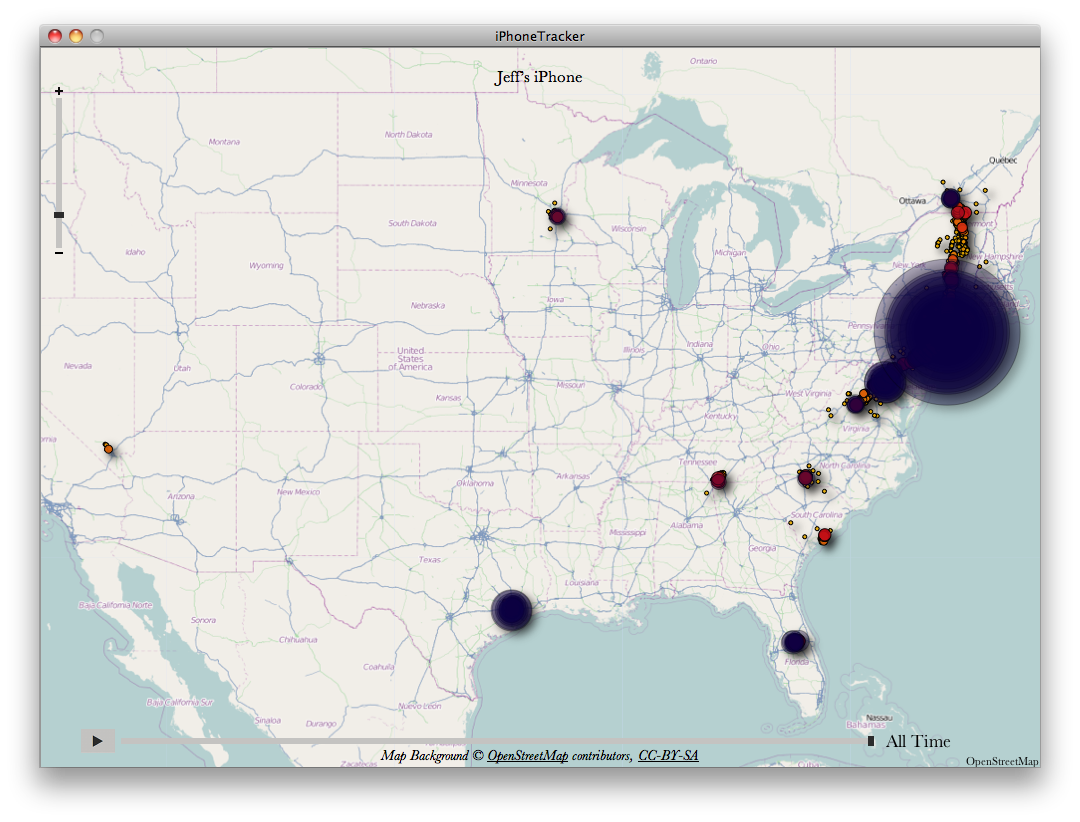
As you might have heard, it turns out that the iPhone keeps a record of everywhere you’ve been. It’s been doing this since last summer. It’s kind of creepy, but also kind of cool, so I downloaded the iPhone tracker program by Alasdair Allan and Pete Warden that turns the data on your iPhone into a map. Here’s my map (click to embiggen):

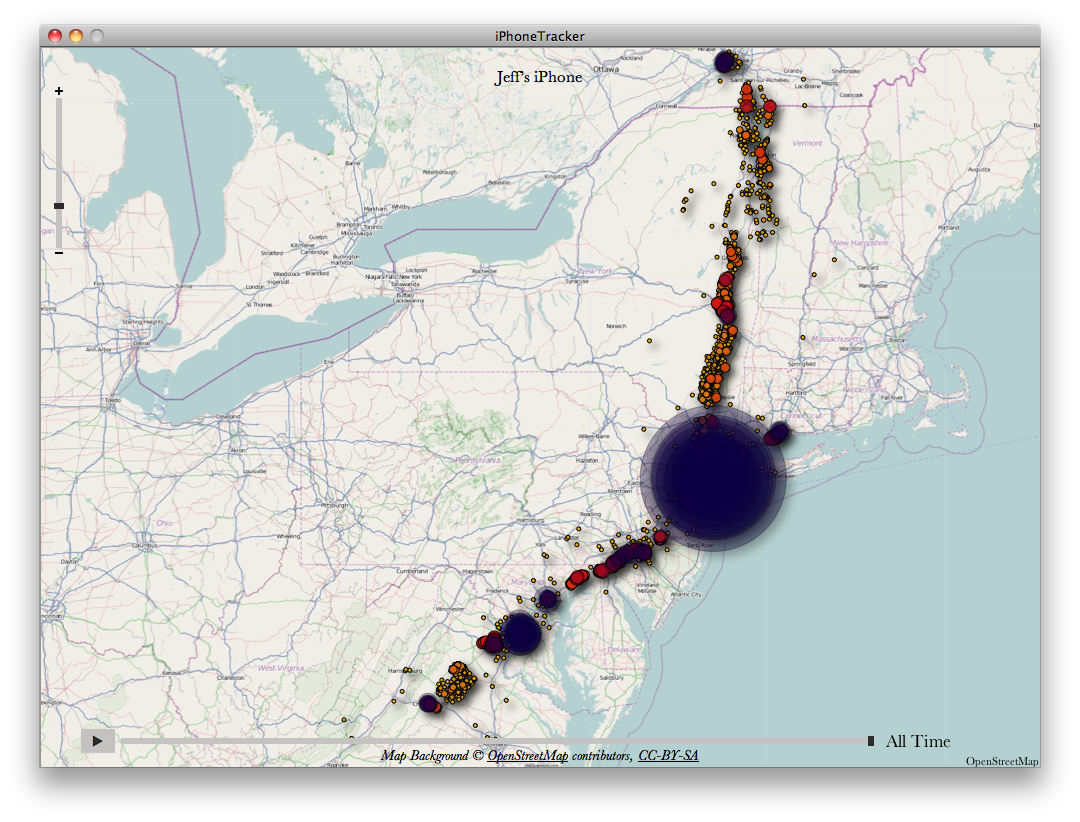
Here’s my map for just the northeast:

I think the tracking works by bouncing signals off cell towers or something, so there are some inaccuracies (I haven’t been to New Hampshire, Massachusetts, or central New York State off the I-87 corridor recently). But as I mentioned last week, I’ve gone on an abnormally high number of trips in the last several months, so there’s a lot on here. My map reflects vacations, airport transfers, my Amtrak trip to Charlottesville, Virginia, my NJ Transit commute to and from work, our car ride to Montreal, etc.

There are two weird things, though:

(1) It shows my phone as having been in Las Vegas. I haven’t been to Las Vegas in years. But when I press the time-lapse arrow at the bottom of the screen, I see that my phone was in Vegas the same week that I bought it at an Apple Store in NYC. It must have been in Vegas before being shipped to NYC; there must be a warehouse in or near Vegas where they store and test new iPhones before shipping them around the country.

(2) I was in Alberta, Canada last summer, but that’s not reflected on the map. I think that’s because I had my phone turned off or didn’t use it or something, because I didn’t want to roam and use data. But I was in Canada again a few days ago (Montreal), and I still had roaming turned off, but that data still shows up. I must have done something differently but I can’t remember what.

Anyway… creepy, but cool.