
Parting the Waters

parting-the-waters.jpg

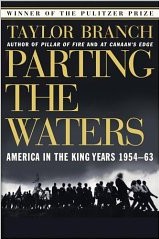
I’m about a third of the way through Parting the Waters: America in the King Years, 1954-1963, by Taylor Branch. Parting the Waters is the first book of Branch’s massive trilogy interweaving the history of the black civil rights movement with the life of Martin Luther King, Jr. The first book alone is 922 pages; together the three books are about 2,300 pages. (I’m not counting acknowledgements, endnotes, index, etc.)

Parting the Waters is absorbing. It really brings the chaos of the era to life: bus boycotts, marches, bombings, jailings, political machinations, internal dissension within the civil rights movement. It seems like half the movement involved creating plans and the other half involved scrambling to respond to unforeseen events.

I’m not really setting out to finish the book — it’s just that I keep reading it and it keeps being interesting. I started the book because I wanted to read something meaty, and for a long time it had been on my mental list of things I eventually wanted to read in my life. (It’s long been acclaimed and it won the Pulitzer for History in 1989.)

Partly because February is Black History Month and partly because Barack Obama has broken so many racial barriers lately, the book seems particularly appropriate right now. Unfortunately, since it’s a biography of Martin Luther King, we know how the story ends.

Martin Luther King, Jr. would have turned 79 last month. He wouldn’t even be 80 years old today. That brings home with great clarity how young he was when he was assassinated, and how much life that assassination deprived him. It’s jarring to take him out of the myths of history and imagine him living on into the present — which, under normal circumstances, he would have.

I wonder what he would think of Barack Obama?
Rove at Choate

35510528.jpg

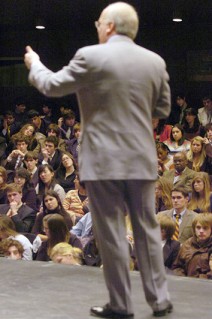
Karl Rove spoke to students on Monday at Choate Rosemary Hall, the well-known Connecticut prep school. One student challenged him on gay marriage. He couldn’t seem to give a good reason for banning it. Go figure.

[Marla] Spivak, a senior from Hamden, was one of the students invited to have lunch earlier with Rove. That left her somewhat emboldened as she stood before the crowd and asked Rove to explain how giving gay people the right to marry would endanger other people.

Rove took issue with the way the first gay marriages came about, through the Massachusetts Supreme Court. An issue as important as the definition of marriage should be resolved by a legislature or a referendum, not a court, he said.

Gay couples could gain the legal rights of married couples through legislation without actually getting married, he said.

But wouldn’t creating a separate body of legislation for gay people be creating a separate but equal system, a step back?, Spivak asked.

Rove replied with an answer about Mormons changing their views on marriage to conform with the nation’s laws.

Spivak kept pressing. “You never actually answered, how does it threaten anyone?” she asked.

Rove asked, what’s the compelling reason to throw out 5,000 years of understanding the institution of marriage as between a man and a woman?

What, Spivak countered, was the compelling reason for society to allow interracial relationships when they had once been outlawed.

Then Rove invoked the Declaration of Independence before Spivak interjected that its reference to “life, liberty and the pursuit of happiness” seemed to support her claims.

Their verbal pingpong match tapered off after Rove brought up polygamy and Spivak acknowledged that she did not know enough about polygamy to answer. Rove later asked when she planned to run for political office.

Karl Rove, of all people, couldn’t come up with a good reason for banning gay marriage.

I love this Marla Spivak. I’ve sometimes fantasized about debating some of these people face to face. She was able to do it and didn’t let him off the hook (at least until it came to the lame argument about polygamy).

You go, girl!

Journalistic Query

Do you lack health insurance or are you underinsured? A journalist friend of mine wants to talk to you.

I’m writing a feature about the differences between the presidential candidates’ health plans, and am looking for New Yorkers who either lack insurance or are underinsured. Do you know of anyone in this situation who’d be willing to be interviewed and photographed? Basically I’d like to find someone who works, either for themselves or a small employer that can’t afford policies for their staff, and has either taken the gamble to go without coverage or has bought a policy on their own – maybe a policy they still own, or one they have since let go of because it cost too much. They should know up front that I’d be asking them somewhat personal questions – what their health care needs are, how affordable care is based on their salary and other basic expenses, and what they would like to see change in access to coverage following the election.

I prefer five-borough residents, but Long Island, Westchester and North Jersey are also OK. I’m hoping to get the interviews and photo shoots wrapped up in the next couple days.

Let me know if you’re interested and I’ll pass your information on.