
The Declaration of Independence

“One of the most widely held misconceptions about the Declaration is that it was signed on July 4, 1776, by all the delegates in attendance.”

The Declaration of Independence: A History
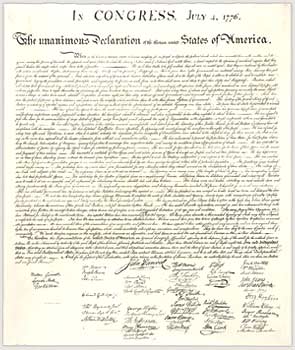
Declaration of Independence

Happy Independence Day!

The American colonies actually chose independence on July 2, 1776. The Declaration wasn’t signed until August 2, 1776, and all the signatures weren’t even added that day. But we celebrate July 4 because that’s the anniversary of the finalization of the text.

On June 7, 1776, Richard Henry Lee of Virginia presented to the Continental Congress, representing the 13 colonies, a resolution for independence from Great Britain. A Committee of Five was soon appointed to draft a statement of independence, and it worked throughout June. Among the five members of the committee (which also included Benjamin Franklin and John Adams), Thomas Jefferson was given the task of actually drafting the document.

On July 1, Congress reconvened.

On July 2, all 13 colonies except one adopted Lee’s resolution: New York abstained.

Revision of Jefferson’s document was completed by Congress on the morning of July 4, at which point the resolution was considered officially adopted.

The first printed copies of the Declaration of Independence were turned out from the shop of John Dunlap, official printer to the Congress… On the morning of July 5, copies were dispatched by members of Congress to various assemblies, conventions, and committees of safety as well as to the commanders of Continental troops. Also on July 5, a copy of the printed version of the approved Declaration was inserted into the “rough journal” of the Continental Congress for July 4. The text was followed by the words “Signed by Order and in Behalf of the Congress, John Hancock, President. Attest. Charles Thomson, Secretary.” It is not known how many copies John Dunlap printed on his busy night of July 4. There are 24 copies known to exist of what is commonly referred to as “the Dunlap broadside,” 17 owned by American institutions, 2 by British institutions, and 5 by private owners.

The Dunlap broadside.
Dunlap broadside, July 5, 1776

On July 9 the action of Congress was officially approved by the New York Convention. All 13 colonies had now signified their approval. On July 19, therefore, Congress was able to order that the Declaration be “fairly engrossed on parchment, with the title and stile [sic] of ‘The unanimous declaration of the thirteen United States of America,’ and that the same, when engrossed, be signed by every member of Congress.”

During July, the document was engrossed – written out in a long, clear hand – and on August 2, 1776, what we familiarly know as the Declaration of Independence was signed, starting with John Hancock, the President of the Congress. But that’s still not exactly the image we’re familiar with.

By 1820, the ink on the original Declaration was starting to fade, so Secretary of State John Quincy Adams commissioned an official facsimile. It took three years; it was completed by William J. Stone in 1823, probably etched into a copper plate for easy, endless printing, “with the greatest exactness and fidelity.”

That’s the image we’re familiar with today.

The Stone facsimile.
Stone facsimile, 1823

More links:

The Declaration of Independence: A History – an essay about the creation of the Declaration and the travels of the original document since that time. (Most of this blog post is taken from there.)

The Stylistic Artistry of the Declaration of Independence – an essay about the document’s writing style. “The Declaration of Independence is perhaps the most masterfully written state paper of Western civilization… no assessment of it can be complete without taking into account its extraordinary merits as a work of political prose style.”

Declaring Independence: Creating and Re-creating America’s Document, an exhibit at the University of Virginia.

Happy Independence Day.

Robles Rumors 2

I’m a few days late, but Gay City News reported a few days ago :

Roberta Kaplan, the dynamic attorney who was one of the leads arguing for the right of same-sex couples to marry before New York State’s Court of Appeals in May, said that a decision in the case is “likely” to come down this coming Wednesday or Thursday – July 5 or 6 – unless the six out of seven high court judges who heard it are tied 3 to 3.

As I wrote here, I don’t know what any of these expectations are based on. I still think it would be unusual for the court to rule so quickly on such a non-emergent matter. Of course, Roberta Kaplan is an attorney on the case and I’m not, so perhaps she knows something we don’t know.

Anyway, the above-linked article has some interesting in-depth analysis of how the several judges on the New York Court of Appeals might vote in the case.

Pathfinder

Lately I’ve begun working with a book called The Pathfinder: How to Choose or Change Your Career for a Lifetime of Satisfaction and Success, by Nicholas Lore. It’s helped me figure out that I already know what my dream job is – it’s just been buried under too much self-doubt, fear, skepticism, and most of all, self-preservation.

My dream job, if I could achieve it, would be to become a paid author, commentator, essayist, columnist, et cetera, and make enough money on this to have a comfortable living, and be well-known enough to get invited onto talk shows and radio shows and opine. I’d love to be the next Michelangelo Signorile, Andrew Sullivan, or Dan Savage (gay essayists), or the next Jeffrey Rosen or Jeffrey Toobin (legal essayists), or what have you.

I have no idea how to get paid as a writer or if I’m any good. But I’m afraid to even try because I’m afraid I won’t be good enough. And the concept of actively working to become better at something is a foreign concept to me. I feel that if I’m not good enough at something, there’s no point in working at it and trying to become better, because it’s only inherent talent that is rewarded, and if my talent isn’t inherently mind-blowing, I’m a fraud. In other words, a primitive part of me thinks that people are rewarded for who they are instead of what they do. But I have to unlearn that.

As a first step toward something – I’m not sure what – I started writing a column-length piece this morning, 800 words. I was a university newspaper columnist in college and law school, but it’s been a long time. And it’s harder than I remembered. There’s something so stilted about the process. I think I’m trying too hard to write something presentable. I’m not being personal enough, I’m not putting enough of my own spin on it. Ordinarily, I would take that as a sign that obviously I don’t know what the hell I’m doing, I can’t possibly measure up to those who are getting paid to do this, and how dare I even bother trying. But instead I’m going to try to learn from the experience.

I’ve been thinking of creating a new website that I can use as a showcase for myself and my writing. For a few years I’ve owned the dot-com that contains my name, so I could put it there. Or I could just put it here. The point is that I worry too much about actively making my name public and maybe I don’t need to. I’m not really anonymous here, but it’s not necessarily easily to find my blog if you know my name. This is because I worry about employers or potential employers. But if I’m going to enter a field where it doesn’t really matter what my opinions are or if I voice them, I should be unafraid to publicize myself.

For the past five-plus years of writing this blog, I’ve subconsciously harbored the hope that someone will come across my fabulous writings and decide to hire me on as a writer, or at least ask me to write stuff for them. But it hasn’t happened. Things like that don’t happen if you’re passive. You have to seek those things out.

If this is really what I want, I really need to take action.