One final reminder:
Tonight.
7:30 p.m.
P.S. 122.
150 1st Avenue at East 9th Street.
WYSIWYG presents:
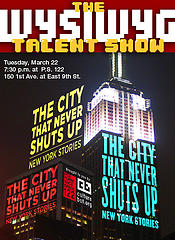
With Eurotrash, Maccers, Ultrasparky, Giulia Rozzi, Joe Jervis, and me.
God help me.

One final reminder:
Tonight.
7:30 p.m.
P.S. 122.
150 1st Avenue at East 9th Street.
WYSIWYG presents:
With Eurotrash, Maccers, Ultrasparky, Giulia Rozzi, Joe Jervis, and me.
God help me.
Regarding the Terri Schiavo matter: I think Scott Rosenberg says it well.
I’ve been fascinated by the case these last few days. Putting aside the political circus, I don’t understand why parents would want to keep a daughter alive who’s been brain-dead for 15 years. I’m not a parent and I can’t fathom the emotions and pain involved in such a decision, but it seems to me that after 15 years, now that “much of her cerebral cortex is simply gone and has been replaced by cerebral spinal fluid,” it’s time to let her go. Aren’t there any other family members or friends who can convince them of this? What’s the point in being technically alive if you don’t even know you’re alive? How does Terri benefit from this?
As far as who has the legal authority to make the decision, it’s clearly the husband. He is her next-of-kin.
It makes me wonder, though: imagine this is in Massachusetts. The brain-dead person has a same-sex spouse, who — reverse the roles here — wants to keep her alive. The parents, meanwhile, are suing to let her die. What would the far-right conservatives do? Would they support the legal right of the same-sex spouse to keep her alive? Or would they support the parents’ desire to let her die?
Eh, they’d probably find a way to have their cake and eat it, too. Still, one wonders.
I’ve taken my own advice. Since Friday morning I’ve been doing morning pages again. I’ve done them four mornings in a row now, and I can feel the ice starting to break a bit. Mostly I’ve been complaining on paper, but my pen will sometimes lead me down interesting alleyways. It’s thought-by-writing. No solutions to anything yet, but it lets me vent, and at least I know that I’ve already done something productive before breakfast.
I’ve almost finished reading Cloud Atlas, one of the weirdest and coolest novels I’ve ever read. To describe it is to ruin it. Just trust me that’s it’s a great (and at times challenging) read.
I sometimes wonder if reading is just a distraction from writing. I tell myself it’s useful, that it can give me ideas and inspiration and fuel. But the truth is that reading is easier than writing. And it’s also more interesting. But it’s consumption instead of production. Last year there was a kerfuffle over a report by the NEA stating that reading among Americans is at an all-time low. That’s bad; reading trains the mind. Or does it? Maybe reading doesn’t cause intelligence and it’s just that intelligent people are the only ones who read.
I was trying to find this Ralph Waldo Emerson quote about how books are actually bad for you. With the help of Google (a brain’s best friend!), I found this, which pretty much says what I wanted to say.
Even the great books, says Emerson, fail to deliver on their promise. “Come, they say, we will give you the key to the world.” Each poet, each philosopher says this. But we never get to the center. What we must draw on is our own experiences. Write our own sentences. And read Emerson. …
… The golden sentences in Emerson should inspire us. They will help us understand our own experience. They may express it better than we ever will. But we cannot stop there. We must have our own thoughts, make our own sentences. …
This is why writers have a love-hate relationship with books. We read books looking for that sudden revelation of truth and by doing so delay revealing our own. “To put away one’s original thought in order to take up a book,” writes Schopenauer, “is a sin against the Holy Ghost.”
There you go. A love-hate (or at least love-annoyance) relationship with books. I’ll finish this book, and then, instead of finding another one, maybe the one that will solve everything, why not just sit down and write?
Instead of passively consuming, actively produce.