The President’s House II

I finally finished reading The President’s House on Thursday. It’s a comprehensive two-volume history of the White House, 1,231 pages long, from the building of the house through the present; the Clinton and Bush II years are covered in an epilogue, because most of their administrations’ papers haven’t been released yet. I bought it the day after Christmas and started reading it over the holidays. Every workday from the beginning of the New Year until last week, I lugged the first volume, and then the second, back and forth with me on the subway and train to and from work.

I know so much more about the house, the presidents and their families than I did when I first started. Fascinating stuff.

And now I have to find a new book to read on my commute. Until I do, I’m catching up on my New Yorkers.

WH West Sitting Hall

A couple of months ago I discovered Google Sketchup, a free 3D modeling program. I found it when I stumbled across some great 3D models of the White House on WhiteHouseMuseum.org. I’d always wanted to try 3D modeling, but I never realized I could do it for free.

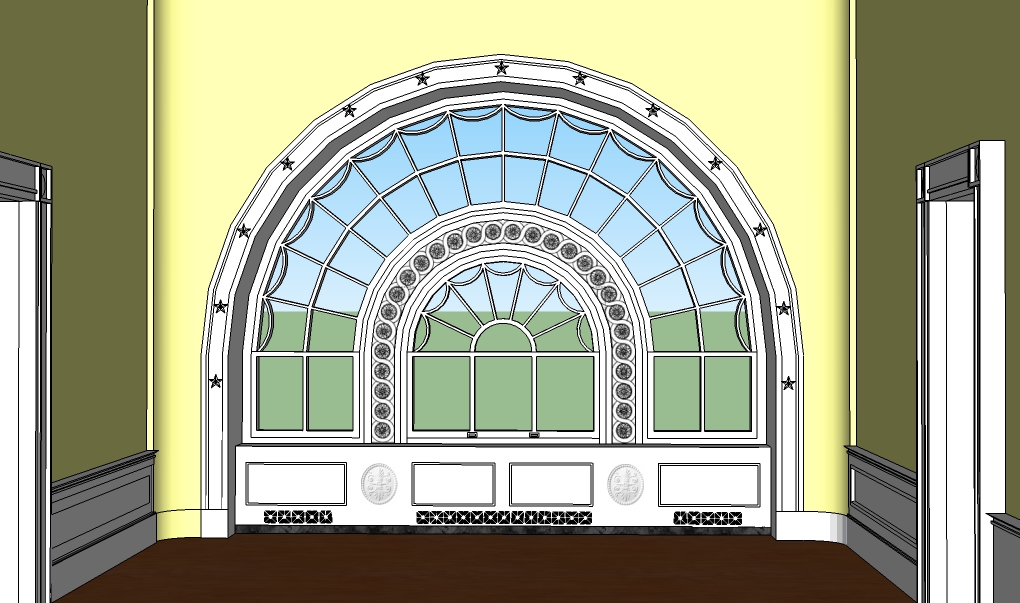
So intermittently over the last couple of months I’ve been working on my own model of the second floor of the White House. I started by tracing this floor plan. I’ve primarily been working on the West Sitting Hall [Wikipedia]. It’s the room where Michelle Obama and Laura Bush sat when the Obamas visited the White house shortly after the election. I love that large fan/lunette window; it’s gorgeous.

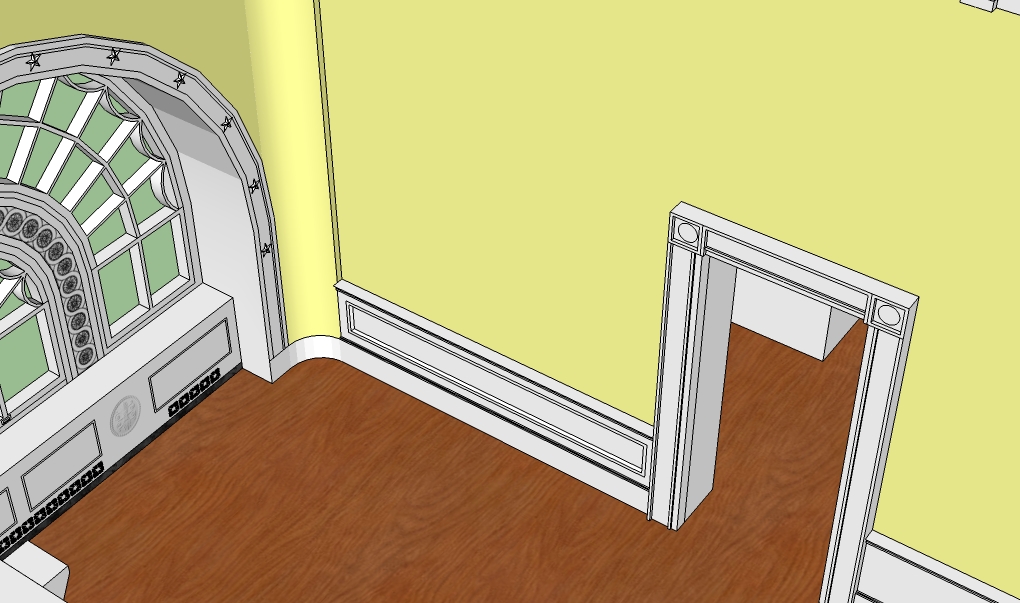
The floor of my model isn’t accurate yet, and there are other details I still need to add (for instance, the molding doesn’t extend all the way to the lunette window yet) or play around with, but here’s my work on it so far.

Overhead view (click to embiggen):

west-sitting-hall

Close-up of the lunette window:

lunette

Alternate angle:

window-door

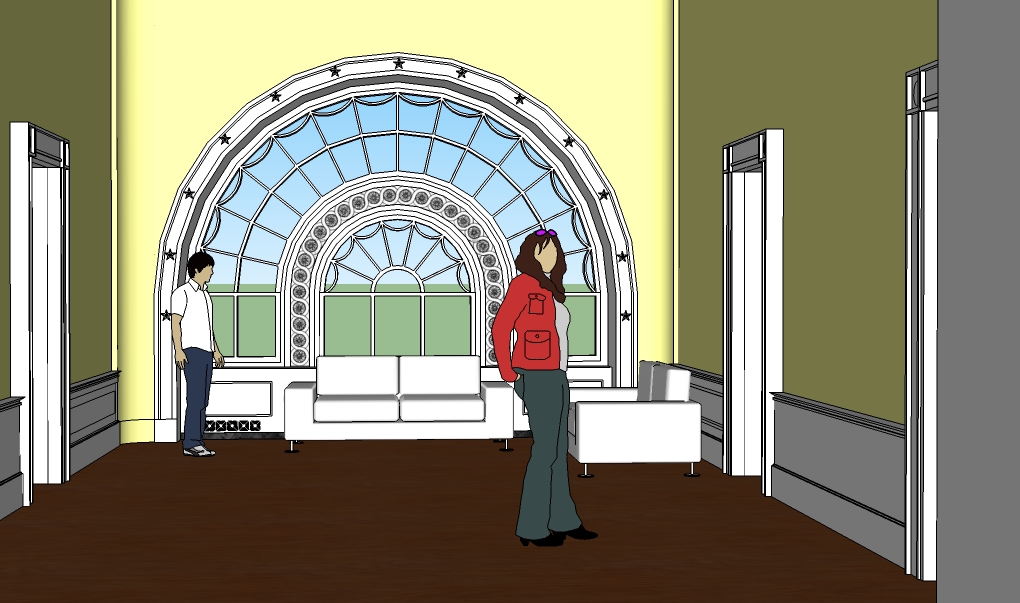
And here it is with a few stock people and couches thrown in. I’m not positive I have the scale right yet.

with-people

I’m not sure exactly what I’m going to do with this, but it’s fun.

JG Jr.

Last night while riding the subway home I saw one of my theater crushes: John Gallager, Jr., who originated the role of Moritz Stiefel in “Spring Awakening” on Broadway. I was standing on a crowded subway reading a book, and when I turned around to get off at 96th Street, I saw him getting up from a seat near me and getting off the train also. He looked very Brooklyn musician.

I admit I started to trail him a little bit to see if he was waiting to transfer to the local train or exiting the station. But then a man with a little kid called out his name, and it turned out they knew each other. So I listened to their conversation for a few minutes while pretending to read. The kid gave him a piece of candy. Then the local came, and the man and his kid got on, as did I. John Gallagher, Jr., didn’t.

I love New York.

DFW Profile in NYer

There’s a long article in this week’s New Yorker about the life and death of David Foster Wallace. As I’ve written about before, I love Wallace’s writing. Thinking about him takes me back to the summer when I was 23 and living at my parents’ house in New Jersey, feeling like a lonely, empty vessel, reading Infinite Jest and not knowing what to do with my life. Wallace’s words just make me want to write. He makes me feel that it’s okay to embrace the chaos in my complicated head and get it down in words.

Wallace committed suicide in September at age 46. He suffered from depression his whole life, but nobody outside his immediate circle knew about this until after he’d died.

In his senior year of high school, he began carrying a towel around with him to wipe away the perspiration from anxiety attacks, and a tennis racquet, so that no one commented on the towel.

A few years ago, after struggling with depression and addiction and directionlessness, he got some things sorted out, and he fell in love and married a visual artist named Karen Green.

Wallace was thrilled that his personal life was in order: he took it as evidence that he had matured. He teased Green about what a good husband he was. She remembers him saying, “I took out the garbage. Did you see that?” and “I put tea on for you when you were driving home.” Green was a good partner for Wallace, too—supportive and literate, but not in awe of her husband. “We used to have this joke about how much can you irritate the reader,” Green recalls. He could be needy. At night, he would beg her not to get sick or die.

He was working on another novel when he died, which he was calling The Pale King. He’d “only” written a few hundred pages. The unfinished novel is going to be published next year. It is apparently about boredom — or, rather, about how to get past boredom:

The novel continues Wallace’s preoccupation with mindfulness. It is about being in the moment and paying attention to the things that matter, and centers on a group of several dozen I.R.S. agents working in the Midwest. Their job is tedious, but dullness, “The Pale King” suggests, ultimately sets them free. A typed note that Wallace left in his papers laid out the novel’s idea: “Bliss—a-second-by-second joy and gratitude at the gift of being alive, conscious—lies on the other side of crushing, crushing boredom. Pay close attention to the most tedious thing you can find (Tax Returns, Televised Golf) and, in waves, a boredom like you’ve never known will wash over you and just about kill you. Ride these out, and it’s like stepping from black and white into color. Like water after days in the desert. Instant bliss in every atom.”

The magazine also includes an excerpt from the novel. It portrays mind-crushing dullness, but as I was reading it, I felt fear. Soul-crushingly boring work is scary, because (1) how do you get through it? and (2) at the end of the workday, you are one day closer to death and have nothing to show for it.

The Pale King seems to be the other side of Infinite Jest. IJ is about modern American unhappiness, addiction to entertainment, and isolation. Addiction is the child of boredom (of course, it can also be genetic); isolation and boredom can turn into addiction, as we desperately look for things to distract us from the pain of being lonely. Or just from the pain of being sad. Apparently The Pale King is about how to get past the pain of boredom.

The last few paragraphs of the New Yorker piece are sad themselves. This part wounds me:

Green believes that she knows when Wallace decided to try again to kill himself. She says of September 6th, “That Saturday was a really good day. Monday and Tuesday were not so good. He started lying to me that Wednesday.”

He started lying to her — not sharing his terror and sadness. Isolating himself emotionally. Betraying the person he loved — not because he was a bad person but because he just couldn’t communicate what he was feeling. As he wrote in his short story “The Depressed Person”:

The depressed person was in terrible and unceasing emotional pain, and the impossibility of sharing or articulating this pain was itself a component of the pain and a contributing factor in its essential horror.

When I really think about it, I find it hard to trust Wallace’s view of the modern American condition, because he extrapolates from his own subjective experience of living. His depression and agony were not caused not by modern American life; they were caused by a chemical imbalance. But there are essential truths in what he writes about: boredom, isolation, the fear and desolation that result from the inability to connect with other people emotionally.

I’m looking forward to the published novel.

Capitalists

Goddamn economy.

We found out yesterday that due to cost cuts, our office is closing in less than three months and we’ll all be consolidated into a different office 13 miles away. Thirteen miles doesn’t sound like very much, but this is northern New Jersey, where car traffic and mass transit warp the laws of space and time. Many of us in the office live in NYC and commute by train into Newark every day. It currently takes me about an hour to get to work; my new commute will be an hour and 40 minutes. Each way.

Even the people who live in New Jersey and drive to work will have a longer commute, because, again, commuter traffic in New Jersey sucks.

It’s possible I’ll be able to telecommute a few days a week. Otherwise I don’t know how I’m going to do this.

Nobody is happy about it. At least we’re not being laid off, but sometimes being zen and looking on the bright side only gets you so far.

So I need some time to be angry.

TwitterFace

I’m annoyed that Facebook status updates and Twitter tweets have become the new blogging. It’s no surprise I feel that way, since I’m a blogging old-timer. But I think Homer put it best (see his entry from March 5 — I can’t link to the actual post): “I wish people would return to blogging and telling stories rather than telling me that they ‘hate their job’ or ‘have a meeting to go to’ or ‘I’m going to the gym.'”

Granted, some people can elegantly tell a story in one short sentence, and some people can blog for paragraphs about inane topics. (Guilty.) But sometimes status updates and tweets are little more interesting than this.

Of course, I’m only *partly* annoyed, because I myself write Facebook status updates sometimes. I just find it hard to encapsulate most of my thoughts in 140 characters or less.

I haven’t hopped onto the Twitter bandwagon, though — even though I kind of want to because, hell, it seems cool. Everyone’s doing it! The thing I hate about Twitter is when people write “private” tweets to other people. You can tell a tweet is directed at a particular person because the writer uses the @ sign. For example, “@johndoe: I totally agree, that was hilarious.” It’s like showing other people how cool you are by publicly having exclusive conversations with someone else. If you’re going to have a private conversation with someone, have a private conversation.

The same goes for people who write private messages on other someone else’s Facebook Wall. Maybe they don’t realize that everyone can see your Wall. But we can. When you write, “Hey, it’s been a long time! How have you been?” on someone’s Wall, everyone can see it.

I feel a little bit like Andy Rooney. You little whippersnappers with your Facebook and your tweets. Back in my day, we had to write blog posts about walking eight miles uphill in a snowstorm to get to school…

Watchmen

Yesterday afternoon I was dragged to see Watchmen, and I’m glad I was. I had no desire to see it, because the trailer didn’t do anything for me, but I enjoyed the movie much more than I’d expected. The last 20-25 minutes were a letdown, but otherwise I was totally pulled in.

Watchmen is an adapation of a 12-part comic book series that came out in 1986-87 and was eventually collected into a graphic novel. I’d long heard of it but had never read it, which is weird, because it came out during my comic-book-reading heyday. I guess I was more interested in classic DC Comics characters at the time and wasn’t interested in reading something so dark and adult.

What I really enjoyed about Watchmen is how it both honors and subverts classic comic book tropes and history. (I guess you could say it deconstructs them.) Woven throughout the story are references to a classic 1940s superhero team, which seems loosely based on the Justice Society of America, precursor to the more famous Justice League of America. The heroes experience a postwar fall from grace, parallelling America’s deteriorating view of itself from the end of World War II through the 1970s and 1980s. Watching the movie, I liked how we got a sense of history and continuity — some larger reality out there of which we only see pieces.

Film adaptations rarely live up to the original source material — they always compress it. So I’m interested in reading the graphic novel now, in order to experience the whole thing.

Batman #384

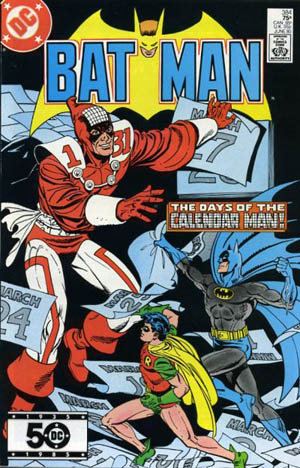
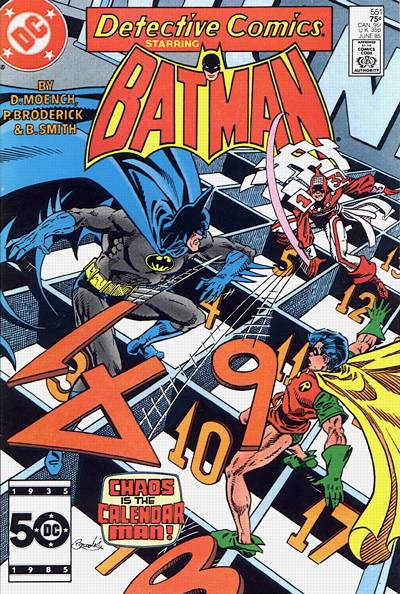
The first comic book I ever bought was Batman #384, in March 1985. This was the cover:

batman384

(OMG! The Calendar Man! Run before he steals your daily planner!)

(By the way, it says “June 85” because comics were cover-dated three months into the future.)

I was 11 years old. My parents were away on vacation and my grandparents were staying at our house to watch me and my brother. I was a big fan of the “Superfriends” TV show — especially Batman and Robin (I also liked watching reruns of their 1960s series, although the camp factor went over my head). I played with my Super Powers action figures all the time, and I wanted to buy a new one. So I had my grandpa walk with me to the local newsstand/drugstore a few blocks away to see if they had any.

They didn’t, so I was disappointed. But I spotted a tall metal rack of colorful comic books on a rotating stand. There he was on one of the covers: Batman. I’d never read a comic book before, but I figured if I couldn’t get an action figure, I might as well read one of these. And it only cost 75 cents, so why not?

That was the beginning of a love affair that lasted several years. Batman’s battle against the Calendar Man ended in a cliffhanger, so I had to pick up Detective Comics #551 to read the conclusion (a much cooler cover, I think):

detective_comics_551

I was addicted. From Batman and Detective Comics, I branched out to Superman and Action Comics, and then I discovered Crisis on Infinite Earths, which was unfolding at the time. This was a 12-part series that remade the entire DC Comics universe from the ground up, in honor of DC’s 50th anniversary, and it introduced to me to the vast canvas of heroes and villians that had existed over decades. Superheroes were so much more than the one-dimensional cheesy portrayals I’d seen on TV.

I looked forward to Fridays. Every Friday after I got home from school, I’d walk to the same store where I’d bought my first comic. There in the rack were the week’s latest offerings. I’d pick out the two or three (or four or five) that I wanted, and the cashier would ring them up and put them in a little bag for me. I’d carry them home and spend Friday night catching up on the latest developments in the lives of my heroes.

For three years I did this. But in high school we moved to Japan, where I despaired of ever keeping up with my comic book habit. Fortunately the Tokyo American Club had a bookstore where I could buy comics a few months after they were published, but they were only there sporadically, so it wasn’t the same. (And I’d miraculously developed a social life and gotten involved in theater, so I had less time for comics anyway.)

A couple of years after I started college I got back into comics again, but it didn’t last too long. They’d gotten too expensive and too glossy. The publishers had realized that adults liked to not just read, but also collect, comics, so they would publish special editions with multiple covers, and there were more and more titles to follow. I started to feel manipulated and bored. So I quit.

My comic book collection still sits in my parents’ basement. My dad has been pestering me for years to get it out of there. I don’t mind selling most of them, if I could figure out how. I just know that I could never sell those first few comics I bought — Batman #384, Detective #551, maybe not even Superman #408

…unless, of course, someone were to offer a few thousand dollars for them. But they’re not that valuable.

New Radicals

I was just listening to this song on my iPod: “You Get What You Give,” by the New Radicals (who pretty much fell off the face of the earth after it came out). I’ve been in love with it ever since it first came out around 10 years ago — seriously, it was love at first hear. It’s so catchy and upbeat and fun, with great pop piano chords that just really push my happy button. Sometimes it makes me so happy I get teary. And it doesn’t hurt that the lead singer is so darn cute.

I forgot how weird the video is, but it’s really the song that does it for me.

Oh, the late ’90s.

(Update: this one’s pretty nifty too.)

BSG Finale

I thought the finale of BSG was terrific. Then again, I’m usually forgiving of logical gaps when I get emotional closure of plots and character arcs, like I did here. (One of those logical gaps: weren’t the 12 constellations that form the signs of our Zodiac already visible from the radioactive Earth where the cast landed at the beginning of this season? Isn’t that why they knew it was Earth?)

I think it’s rare that writers know how a TV series is going to wrap up when they begin it — or even when they’re halfway through it. It’s just part of the nature of an open-ended TV show, unlike a book or movie that is planned out from the start. Given that the writers surely pulled stuff out of their asses after writing themselves into several corners, I thought they wrapped things up in a remarkably satisfying way. Even though the answers didn’t all make perfect sense, we did get answers, and darn fulfilling ones, in my opinion. (Not to mention a big, crazy-ass battle, which is always fun.)

And those final couple of minutes, with our species’ present-day development of better and better robots as an omen for the future — that creeped me the hell out. Is that where we’re headed?

We always wondered whether BSG took place in our future or in our past. We now realize that it was both, in a way. There is no future or past — everything recurs. Kobol, Caprica, the old Earth… the cycle repeats itself.

There must be some way out of here.

Good Advice

I’m currently reading this book called On Being a Therapist, by Jeffrey A. Kottler. It’s about psychotherapy from the therapist’s point of view. Kottler, a therapist, sets forth a list of the themes that often recur in his advice to patients/clients. I found this list enlightening.

  • If you do not take care of yourself, nobody else will.
  • We will be dead for a very long time.
  • Symptoms are useful in getting your attention.
  • Symptoms will not go away until they are no longer needed.
  • We are all afraid to be alone.
  • If you do not expect anything, you will never be disappointed.
  • One hundred years from now, nobody will care what you did with your life.
  • The material world is seductive.
  • Feeling powerless is a state of mind.
  • We spend our lives trying to control our hormones.
  • No matter what you do or say, half the world will like it and half the world will not.
  • You will never have your parents’ approval.
  • You have less to lose than you think.
  • We will never ever be content for very long.
  • It is hard to love without vulnerability.
  • Change does not occur without risks.
  • We are all afraid of being wrong.
  • We do not like the responsibility of being right.
  • Everything worth doing is difficult.

There we go. Humanity solved. You’re welcome.

(I would amend the last item on the list. Sometimes we don’t do worthwhile things because they seem suspiciously easy.)

Shut Up

This morning I was riding the New Jersey Transit train into Newark. The train car was quiet, except for a woman sitting four rows in front of me who seemed to be leading a business meeting via her cellphone. Four rows in front of me, and I could hear every word clearly. She just kept on talking. The woman would not shut up.

I couldn’t read, I couldn’t doze, I couldn’t drown her out by listening to music on my iPod except by playing something consistently loud, which would defeat the purpose.

After about 15 minutes of her yammering, I decided to move to a different car. I was going to just walk past her to the next car without saying anything, but for some reason I just couldn’t help it. I stopped at her seat, turned around and looked at her, and said, “I can hear you from four rows behind you, by the way.” She grimaced but avoided looking at me. “Stop shouting,” I said as I continued walking to the next car.

I don’t like being dickish to people. Usually I can keep my mouth shut. But I must have been in a bad mood this morning. And people who bleat away on their cellphones on NJ Transit are my number one commuting annoyance.

Why is it more annoying to listen to one half of a shouted cellphone conversation than to listen to two loud people having a conversation? Maybe it’s because when you hear two people, there’s a conversational rhythm that your brain easily gets used to, but when you hear only half a conversation, there’s no rhythm — just erratic bursts of sound interrupted by moments of silence, and your brain keeps having to tune in and out. Also, listening to half a conversation is unnatural, and I think our brains don’t like the fact that half the information is missing. The brain starts trying to fill in the missing information, which distracts you from whatever you’re trying to do. A conversation is like music; imagine muting the sound at irregular intervals for random durations. The brain doesn’t like it.

Either that or I’m just very hypersensitive to noise.

Satisfaction

Our apartment lease is up for renewal on May 1. A few weeks ago we received a letter from our landlord offering to renew the lease with a rent increase of $25 per month.

Ordinarily that would be fine, but in this economy, with rents falling all over the city, any increase struck us as ridiculous. And a search of Craigslist showed that our managment company was offering a couple of other one-bedrooms in our building for at least $500/month cheaper than what we’re currently paying. Obviously their offer to renew with a rent increase was meant for the stupid, timid or uninformed.

So I’m proud of myself that I managed yesterday to negotiate a $533/month reduction in our monthly rent. We’d actually be getting a month free in the new lease, so the total annual rent would be spread over 11 months instead of 12, but over the course of the year it works out to $533/month less. (That explains the awkward amount of the decrease.)

I should be happy about this, but instead, it’s gotten me stressed. Because it entails making a decision. Should we renew at this better rate? Or should we look for a one-bedroom at an even cheaper rate? Or, since I’ll soon be working from home a few days a week and rents are going down, should we find a two-bedroom that is more expensive but still perhaps a little cheaper than what we’re paying now?

I am awful at making decisions, because instead of seeing a few upsides to choose from, I only see the downsides to choose from.

Ultimately we’ll probably renew our lease at the reduced rent. The free month will be an instant jolt of money to the bank account, and we don’t really feel like dealing with a move, and we’re reasonably happy where we are.

This all ties into a big meta-issue I’ve been experiencing in several areas of my life lately. What do you do when nothing in your life is perfect? Do you accept things the way they are? Or do you try to change them, even though perfection is impossible and you don’t know whether a change will make things better or worse? How do you live a happy life when you wish things were different? If you accept imperfection in your life, aren’t you admitting failure? And doesn’t that mean that nothing will ever get better? And if you give up idealism, aren’t you also giving up hope?

Accept the things you cannot change, and change the things you cannot accept, but how the hell do you actually decide which is which?

Still, I at least wrote a journal entry yesterday in which I congratulated myself on the rent negotation. Sometimes I can at least try to be good to myself.