
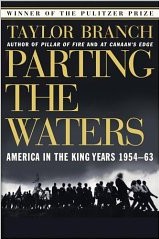
Parting the Waters

parting-the-waters.jpg

I’m about a third of the way through Parting the Waters: America in the King Years, 1954-1963, by Taylor Branch. Parting the Waters is the first book of Branch’s massive trilogy interweaving the history of the black civil rights movement with the life of Martin Luther King, Jr. The first book alone is 922 pages; together the three books are about 2,300 pages. (I’m not counting acknowledgements, endnotes, index, etc.)

Parting the Waters is absorbing. It really brings the chaos of the era to life: bus boycotts, marches, bombings, jailings, political machinations, internal dissension within the civil rights movement. It seems like half the movement involved creating plans and the other half involved scrambling to respond to unforeseen events.

I’m not really setting out to finish the book — it’s just that I keep reading it and it keeps being interesting. I started the book because I wanted to read something meaty, and for a long time it had been on my mental list of things I eventually wanted to read in my life. (It’s long been acclaimed and it won the Pulitzer for History in 1989.)

Partly because February is Black History Month and partly because Barack Obama has broken so many racial barriers lately, the book seems particularly appropriate right now. Unfortunately, since it’s a biography of Martin Luther King, we know how the story ends.

Martin Luther King, Jr. would have turned 79 last month. He wouldn’t even be 80 years old today. That brings home with great clarity how young he was when he was assassinated, and how much life that assassination deprived him. It’s jarring to take him out of the myths of history and imagine him living on into the present — which, under normal circumstances, he would have.

I wonder what he would think of Barack Obama?

Obama v. Clinton on Gays II

I’m actually getting tired of the “who’s better for the gays” debate on Obama and Clinton. I think they’re actually pretty similar when it comes to gay rights.

There’s an interview in the Blade today with Hillary about gay rights. While Obama thinks DOMA should be completely repealed, Hillary isn’t ready to repeal the section that allows states to ignore what other states say about gay marriage.

Ideally, DOMA should be completely repealed. But I do understand Hillary’s support for keeping the part about state recognition, for now. That section of the law does keep some people from supporting the FMA, because they say that as long as states can do what they want, there’s no need for an amendment banning same-sex marriage nationwide. (Same-sex-marriage states can’t “infect” other states, if one were to put it in so unfortunate a manner.) We don’t live in an ideal world.

Also, as I’ve pointed out before, even though same-sex marriage is an issue that’s very important to me personally, there are so many issues that are more important and will affect many more people, such as health care, foreign policy, and a president’s general ability to lead and/or get things done. Same-sex marriage seems fated to remain a state-by-state issue for the foreseeable future.

Some people talk about Bill Clinton’s signing of DOMA in 1996 and say that it wasn’t his idea, that it was forced on him by the Republicans. It’s true that it wasn’t his idea; but he was safely ahead in the 1996 election (which he wound up winning by 9 points) and he didn’t have to sign it. Unfortunately, this was at the beginning of his triangulation-and-Dick-Morris era. He spent no political capital protecting us.

DOMA might very well be the only thing preventing a constitutional amendment against same-sex marriage right now, but I’ll always be peeved at Bill for signing it.