
My First Crossword Tournament: Lollapuzzoola 9

On Saturday I attended my first-ever crossword puzzle tournament: the ninth annual Lollapuzzoola. It’s the second-largest crossword tournament in the US, and the only one held in New York City.

I’ve loved puzzles forever. When I was a kid, my dad used to buy Games Magazine, edited by the great Will Shortz (who is now the longtime New York Times crossword puzzle editor and the nation’s puzzle master), and bring it home from work. When he was done with the issue, I’d take it and do the puzzles myself.

I’ve done the New York Times crossword every day for years. I can’t remember the last time I missed one; when I go on vacation, I do the ones I missed when I get back. I do them by hand — I like the tactile feel of writing on paper — and in pen. (Some people marvel that I do them in pen, but it’s not that impressive; it just makes for a sloppy puzzle when I get a letter wrong and have to write over it really heavily.)

I can do a puzzle pretty fast, but I don’t usually solve for speed. I like to savor the jokes, the witty wordplay, the words I’ve never seen before. Still, I was curious to know how I’d do in a tournament. I just missed out on attending last year’s Lollapuzzoola, because I didn’t learn about it until a week after it had happened. But I downloaded the puzzles on my own and my times were pretty good, so this year I decided I’d sign up and compete in person.

The tournament is hosted by Brian Cimmet and Patrick Blindauer, and it takes place in a church basement on the Upper East Side. This year there were about 230 competitors (a few competitors were pairs, but most were solo). The competition consists of five puzzles, three in the morning and two in the afternoon. Each one is timed. There are two big digital clocks in the room, and it’s on the honor system: when you’re done, you write down your time on the puzzle and raise your hand, and someone comes over to collect it.

Scoring on a puzzle is as follows: the fastest person gets 3000 points, the next fastest gets 2995, the next 2990, and so on, in decreasing five-point intervals. You get a 100-point bonus for completing a puzzle with no errors, and you lose 10 points for each square that’s incorrect or empty.

There are two individual divisions: Express (anyone who was in the top 20% in the previous tournament), and Local (everyone else). At the end of the day are the finals. The top three scorers in each division come to the front of the room and compete against each other by doing a puzzle on a whiteboard while wearing noise-canceling headphones. The Local and Express finalists do the same final puzzle, but the Express clues are harder than the Local clues.

So, how’d I do? Really well! After the three morning puzzles, they posted the scores, and at that point I was 29th out of 230 overall. I was #6 in the Local division, and I was the #2 rookie, i.e. it was my first time at the tournament (designated by an R):
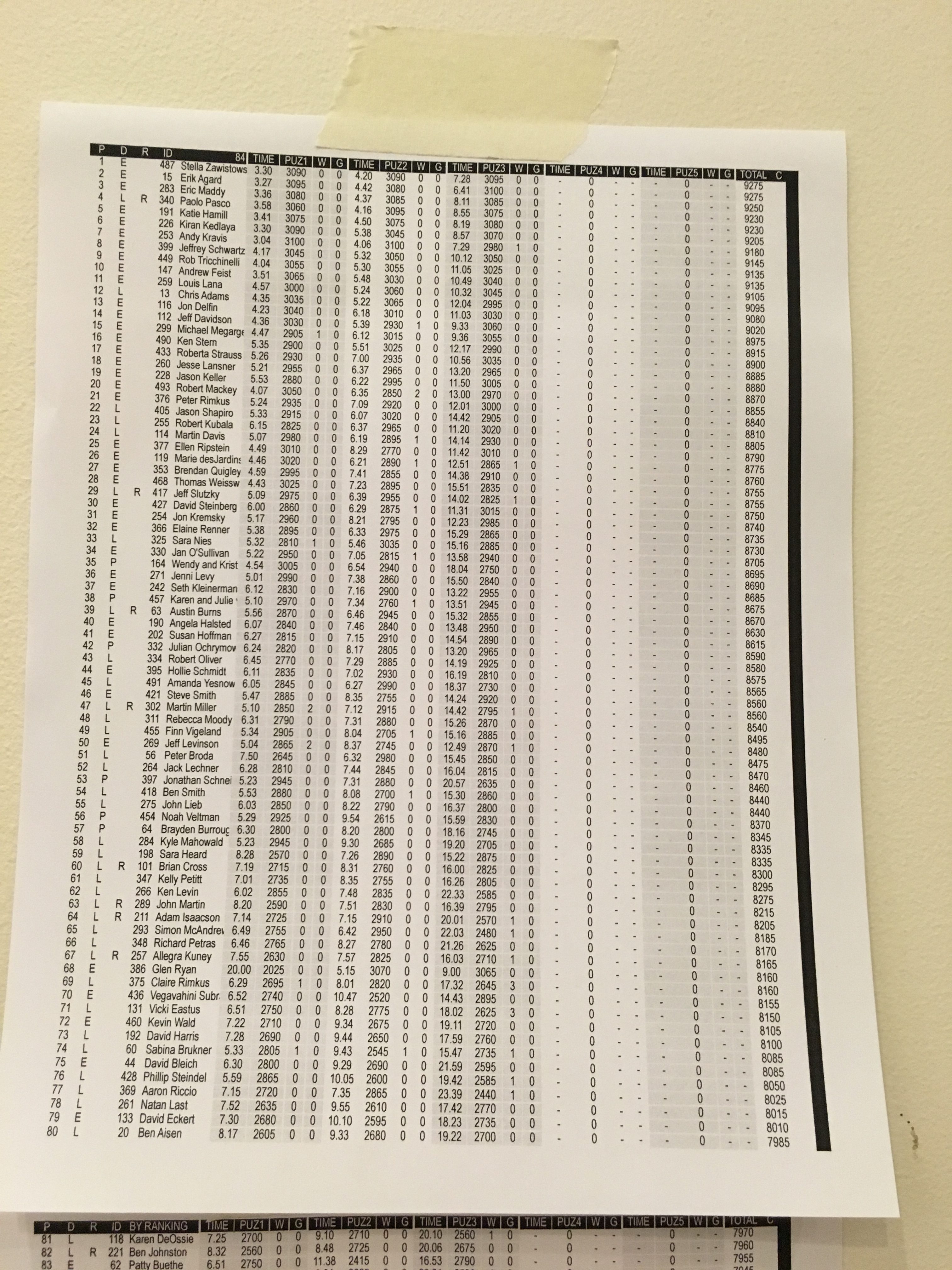
Lollapuzzoola 9

The rookie ahead of me at that point — by a huge margin — was Paolo Pasco, a 16-year-old crossword puzzle constructor.

Someone at my table told me that if I kept doing well and some of the other Locals stumbled, maybe I could make it into the top three. I was hopeful, but I wasn’t counting on it.

After lunch, I did well on puzzle number 4, except I had my second error: The Karate Kid takes place in the city of Reseda, not Peseda. (The first letter crossed with a theme answer, and had I understood that theme better, I might have gotten it right.) But I was still hopeful.

And then, on puzzle number 5… I collapsed. Ugh. Some of the puzzles had been quirky, but this one I just could not get. I couldn’t figure out what was going on with the theme or how the puzzle worked. There were blank lines at the bottom and you were supposed to write something in them. Letters? Words? What was going on? It wasn’t clicking. The seconds ticked by, and other people at my table were finishing before me, while I’d been the first one at my table to finish every other puzzle. I got panicky.

Suddenly I had an aha moment and finally realized what was going on. I turned in the puzzle with what I later realized was an error. (I’ve seen The Apartment twice and Promises, Promises once, so I really should have gotten it right.)

So anyway, I didn’t make it into the top 3 of the Local division. I ended at #12. And I wound up being the #3 rookie. Overall, I was 49 out of 230, which is still very respectable. And since I just missed the top 20%, I get to compete in the Local division again next year.

Oh, and guess who showed up in the afternoon? Will Shortz. I got up the nerve to go over and introduce myself to him. I told him I was a fellow UVA Law grad and that I’d been a fan of his ever since reading Games Magazine as a kid. I was really excited, but I think I played it cool. And I got a photo:

me and Will Shortz

I had a blast at Lollapuzzoola and got to meet some great people. I’m looking forward to going back next year!

Books I Read in 2015

Time for my annual list of the books I read in the past year. As usual, it was mostly history and nonfiction, with a smattering of fiction, mainly sci-fi this year. My reading fell off in September, when I began my three-month coding bootcamp at The Flatiron School. I haven’t finished a book since September, although I started a few that I got tired of.

By far the best book I read this year was Mark Lewisohn’s two-volume, 1,600-page story of the Beatles from their ancestors and childhoods up through the end of 1962, when they were on the brink of nationwide fame. (Beatlemania wouldn’t come to the U.S. for more than another year!) Reading this took two months and some discipline, but it was so worth it, and I look forward to parts 2 and 3 of Lewisohn’s trilogy.

In fiction, The Martian was great, as were parts 1 and 2 of Cixin Liu’s trilogy, and Hugh Howey’s Wool.

Here’s the list:

  • Franklin Pierce (The American Presidents Series: The 14th President, 1853-1857), Michael F. Holt (1/1-1/7)
  • Washington: A Life, Ron Chernow (1/8-2/2)
  • James Madison: A Biography, Ralph Ketcham (2/2-2/20)
  • Empire on the Edge: How Britain Came to Fight America, Nick Bunker (2/24-3/7)
  • A Monarchy Transformed: Britain, 1603-1714, Mark Kishlansky (3/8-3/16)
  • Roger Williams and the Creation of the American Soul: Church, State, and the Birth of Liberty, John M. Barry (3/18-4/3)
  • Bigger Leaner Stronger: The Simple Science of Building the Ultimate Male Body, Michael Matthews (3/26-3/27)
  • How to Change the World: Reflections on Marx and Marxism, Eric Hobsbawm (approx. 1st half) (4/5-4/12)
  • Stalin: Volume I: Paradoxes of Power, 1878-1928, Stephen Kotkin (4/13-5/16)
  • The Three-Body Problem, Cixin Liu (5/18-5/25)
  • The Martian, Andy Weir (5/25-5/29)
  • Wool, Hugh Howey (5/30-6/5)
  • The Beatles – All These Years – Extended Special Edition: Volume One: Tune In, Book 1, Mark Lewisohn (6/10-7/5)
  • We Don’t Need Roads: The Making of the Back to the Future Trilogy, Caseen Gaines (7/2-7/3)
  • The Beatles – All These Years – Extended Special Edition: Volume One: Tune In, Book 2, Mark Lewisohn (7/5-8/4)
  • Catch a Wave: The Rise, Fall, and Redemption of the Beach Boys’ Brian Wilson, Peter Ames Carlin (8/12-8/23) (about 30%)
  • The Dark Forest, Cixin Liu (8/24-9/18)
  • Station Eleven, Emily St. John Mandel (9/21-?) (first few chapters)
  • Alexander Hamilton, Ron Chernow (10/5?-?) (first few chapters)
  • Destiny and Power: The American Odyssey of George Herbert Walker Bush, Jon Meacham (11/10-currently reading)

On Marriage Equality

As of today, thanks to the United States Supreme Court, gay Americans are fully equal citizens, nationwide.

In his 1995 book Virtually Normal, Andrew Sullivan called for an end to all public – that is, government-directed – discrimination against gays and lesbians:

What would it mean in practice? Quite simply, an end to all proactive discrimination by the state against homosexuals. That means an end to sodomy laws that apply only to homosexuals; a recourse to the courts if there is not equal protection of heterosexuals and homosexuals in law enforcement; an equal legal age of consent to sexual activity for heterosexuals and homosexuals, where such regulations apply; inclusion of the facts about homosexuality in the curriculum of every government-funded school, in terms no more and no less clear than those applied to heterosexuality…; recourse to the courts if any government body or agency can be proven to be engaged in discrimination against homosexual employees; equal opportunity and inclusion in the military; and legal homosexual marriage and divorce.

We’re there.

In 2003, gay sex was decriminalized across the country. In 2010, we were permitted to serve openly in the military. In 2013, the federal government recognized our marriages. And as of today, we can get married and stay married all over the nation. Legal gay sex, legal military service, and legal marriage; we’ve won.

Private discrimination still exists in housing and employment, and we’ll see what happens with private parties who provide wedding services. But when it comes to how our governments directly treat us, the governments we fund with our taxes and support with our allegiance, we are equal.

I’m a married gay man, and now Matt and I are married all over the country, even when we visit Matt’s family in Tennessee. When I was young and alone, and scared of these strange feelings about other boys that wouldn’t go away no matter how hard I tried, worried that my parents would disown me if they ever knew, I never could have imagined that I’d live in a world like this – a world where a majority of the Supreme Court supports my equality and the president of the United States (a black man, at that) praises that decision.

I wish I were 20 years younger. Maybe 30 years younger. I wish I’d grown up knowing that I could marry a man as an adult, that I’d live in a country where our public institutions and the head of our government supported my equality. I wonder if my parents would have been more accepting more quickly. I wonder if I wouldn’t have had to come out to them at 19 only to go back into the closet for another five years because they couldn’t accept it for so long. I wonder if I would have started dating earlier than age 24, gotten more relationship experience under my belt, been able to live it up in my college years, enjoyed more of my youth. Maybe I would have even gotten into more than one college if I’d been openly gay; maybe I’d have gone to a school more accepting of gay people than the University of Virginia in the early 1990s. Maybe I wouldn’t have put so much of my life on hold for so long.

But you can’t choose when you are born. You can only choose what to do with your life today, now. There are people older than me who didn’t live to see this day, people who never even found someone to marry. I’m glad I’ve got a long life ahead of me, knock wood.

I’m glad I’m young enough to live in this world and appreciate the rights I have – today.