
Gay Stylebook Entries

The Associated Press has issued its new style guidelines on LGBT-related terms. (Is “LGBT” in there?)

The GLAAD page above also includes links to the style guidelines followed by the New York Times and Washington Post and a history of the AP’s LGBT stylebook updates.

One thing that strikes me is a reference to “the pejorative connotations of words like ‘homosexual.'” That’s true, isn’t it? It can seem pejorative. But it’s weird that it can. After all, the word isn’t a slur – it means exactly what it says: “same-sexual.” I guess what makes it sound off-putting is the clinical nature of it. But it all seems arbitrary. “Fag” is right out, unless you’re a gay person talking about another gay person; “queer,” formerly pejorative, has been reclaimed; “gay” is the preferred term, unless it’s being spoken by a middle-schooler as a put-down (“That’s so gay!”).

I think I’ll just go by “Jeff.”

(N.B.: Almost as arbitrary, and yet also true, is the fact that referring to someone as “Jewish” is fine whereas referring to someone as “a Jew” comes off as awkward and possibly quasi-offensive.)
And I Am Telling You I’m Not the Verizon Guy

I got to meet Broadway composer Henry Krieger today, best known for composing “Dreamgirls.” He works out at my gym, and he had an appointment with my personal trainer right after I did. The trainer introduced us. I told him that Matt plays “And I Am Telling You I’m Not Going” several times a week, is obsessed with the show, and is counting down the days until the movie opens in December. He seemed genuinely flattered. After my session, I was on an exercise bike, and I heard him tell my trainer that he’s not used to getting name recognition. I’m sure he’ll be getting more recognition again once the movie comes out.

I couldn’t wait to tell Matt when I got home. Unfortunately, he was still asleep at 2 in the afternoon. Once I got out of the shower, he was awake, and I told him. He was psyched. Then he told me I had to blog about it so he could link to it. (Clearly it’s taken me a few hours.)

Now that I’ve met Henry Krieger, I need to meet the other two famous people who apparently work out at my gym: Victor Garber and the Verizon guy. (One of the desk workers at the gym asked me if I was the latter a couple of weeks ago. Must be the glasses.)

An Afternoon at MoMA

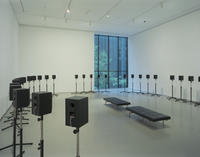
40 Part Motet

Since I live with a New School staffer in a New School building, I was able to get a New School ID card yesterday. One of the things I can do with this card is get into MoMA for free, so I went there today. I went primarily to experience Janet Cardiff’s “40 Part Motet,” which has been at MoMA for several months but is closing on March 21. It’s a room containing a recorded performance of Thomas Tallis’s Spem in Alium, a choral piece for eight five-person choirs. Each of the 40 vocal parts is different. Cardiff recorded a performance of the piece, and the room contains, in a big circle, 40 speakers on stands, with one vocal part emanating from each speaker. You can either sit in the middle of the room and listen to the piece, hearing different voices come from different parts of the room, or you can walk around the room and listen to individual voices. It’s an 11-minute piece and it’s a great experience.

More about the piece here, here and here.

* * * * *

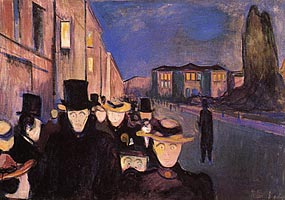
Evening on Karl Johan

I also wanted to see a new exhibit on Edvard Munch, the first American exhibition of his work in almost 30 years. It blew me away. “The Scream” is not there, although there are two early lithographs of it, and there are other works that include the same famous setting, with its blood-red sky. It’s strange to see them; it’s like the stage is set for something spectacular but the star hasn’t yet appeared. His work is so emotional.

I like this quote about “The Scream”:

The power of “The Scream,” I think, owes much to an intellectual resistance that it overcame in the artist. A similar resistance explains the popular tendency to treat that icon of unhappy modern consciousness as a joke in cartoons and inflatable toys. Laughter dies in the face of the supremely matter-of-fact original. It is the touchstone of Munch’s definitive quality in his great years: a self-abnegating submission to emotional truth.

The Munch exhibit runs until May.