Lately I’ve been re-exploring one of my interests: the history of broadcasting and telecommunications. Since I was a kid I’ve loved the early history of radio and TV broadcasting, the rise of the broadcast networks, the transition from radio to TV, and so forth.
I was tooling around online last night and found an RCA television manual from 1946.
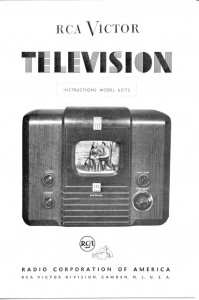
1946 was the year that mass-market TV took off. Television experiments were underway in the late 1920s and throughout the 1930s, and by 1939, mass-market television was ready to go, but World War II got in the way. It wasn’t until after the war, when the economy returned to a peacetime footing and consumers were eager to spend again, that TV really took off on a mass scale. In 1946, a year after the end of the war, RCA introduced its first mass-market TV sets.
It’s funny to scroll through the pages of this manual and see how new and mysterious this all was. I love this from page 4:
Reception of a picture with the accompanying sound from a Television Transmitting Station which is broadcasting in your area is a simple tuning process. The Model 621TS gives station coverage as given on page 12.
Check to see that the Television Station is on the air at the time you wish to tune in, and note the channel number of the station. This information is usually published in newspapers. Program schedules may also be obtained from the station on request.
Ah, yes — “Check to see that the Television Station is on the air at the time you wish to tune in,” because the stations are broadcasting for just a few hours each day. Page 7 has a picture of a test pattern and says, “A test pattern of this type is usually broadcast for about fifteen minutes before the program commences.” Today, that would be a waste of valuable advertising time.
Page 12: “This Television Receiver is designed for operation on all thirteen Television Channels as allocated by the Federal Communications Commission in November, 1945. However, in no area are there stations operating on all channels.”
Page 13 explains that the TV tube and receiver will come in separate cartons:
Do not attempt to unpack the Kinescope or the receiver. Leave the equipment complete with all labels and tags in the two cartons for the technician who will install the receiver and explain its operation.
Great fun. I wonder if someday people will laugh at the instructions for setting up a home wireless network with a router.
