Longtime readers of this blog will know that “Back to the Future” is my all-time favorite movie.
Well, the iconic courthouse square used in the movie was destroyed today in a blaze on the Universal Studios lot.
This makes me sad.
In tribute:

Longtime readers of this blog will know that “Back to the Future” is my all-time favorite movie.
Well, the iconic courthouse square used in the movie was destroyed today in a blaze on the Universal Studios lot.
This makes me sad.
In tribute:
More on Courthouse Square, destroyed by fire yesterday at Universal Studios:
It was where Robert Zemeckis shot the electrifying clock-tower climax with Michael J. Fox in “Back to the Future.” It was also the courthouse backdrop for Gregory Peck’s Oscar-winning performance in “To Kill a Mockingbird.” …
Fans of the old television series “Leave It to Beaver” may recognize the courthouse facade as where the Beav went to school.
And before it was called Courthouse Square, thanks to its use in the “Back to the Future” movies, the area was known as Mockingbird Square because of its extensive use in the 1962 adaptation of the Harper Lee novel.
The Hill Valley clock tower was added to the courthouse for “Back to the Future,” but over the years, filmmakers have removed the clock and redressed the buildings for several films, including Steven Spielberg’s “War of the Worlds,” plus “Bruce Almighty” and “The Cat in the Hat.” It was also used in the 1960s musicals “Bye Bye Birdie” (it was where pop star Conrad Birdie performed to his adoring female fans) and “The Music Man” (as the locale of the “76 Trombones” parade finale).
Courthouse Square was one of the standing sets of the current CBS paranormal drama “Ghost Whisperer.”
The initiative in California to amend the constitution to ban same-sex marriage has qualified for the ballot.
Not a surprise, but still disappointing.
Five months ago today, the Iowa caucuses were held.
Five months from tomorrow is election day.
We’re halfway there…
Chris Cillizza writes about the remarkable nature of Obama’s impending nomination victory:
The facts are thus: Clinton came into the nomination fight heavily favored to be the nominee. Not only did she have the backing of the most potential political machine in the country — due in large part to her husband’s eight years in the White House — but she had also built a vaunted fundraising operation of her own and surrounded herself with some of the best and brightest aides in Democratic politics.
Obama, on the other hand, had served for two years in the U.S. Senate after doing a stint in the Illinois state Senate. He has toured the country for Democratic candidates during the 2006 election cycle and had begun to build a national organization through his Hopefund political action committee. (In fact, Obama often referred to himself as a “skinny kid with a funny name.”)
There seems little dispute that Obama over Clinton deserves a place in the conversation of great political upsets.
Whether it makes you happy or sad, it’s pretty amazing. Clinton was supposed to be the nominee. People had talked about it for years. She was the wife of a popular two-term Democratic ex-president, and she had money and loyalty. The Clinton machine was intimidatingly unbeatable.
And then Obama happened.
Despite the talk of racism hurting Obama among whites, there’s a good argument for the notion that his race helped him as much as his hurt him.
[E]very four years, the candidate who is the new politics, new left darling, whether it’s Howard Dean or whether it’s Bill Bradley or whether it’s Gene McCarthy, has historically fallen on the shoals of the white working-class vote… And that candidate would always make a big splash early in the contest and there would be a lot of media attention… [but] ultimately what would happen is working-class whites and working-class nonwhites would align behind another candidate. …
[I]f you think of the Democratic Party as working-class whites, working-class blacks… and then the elite class, whatever that is, the cappuccino, latte class… and trichotomize the Democratic Party coalition as those three things, if you can get two of the three you’re probably going to be the nominee.
If you see Obama as a black Bill Bradley or Howard Dean, then the reason he did so well is that in addition to the “elite”-type voters, he also got the black voters — unlike Bradley or Dean, who only got the “elites,” while the more mainstream candidate got everyone else. The argument is basically that if Obama had been white, he would have gone the way of his “new politics” predecessors and faded away. Also, by this argument, a large chunk of the white population voted against him not because he’s black, but because he’s the “elitist” candidate. Just as they supposedly wouldn’t support Bradley or Dean, they wouldn’t support Obama, either.
That doesn’t mean there isn’t racism going on as well. Or at least some sort of quasi-xenophobia. As David Brooks writes today:
These independent voters were intrigued by Obama’s “change†message, but they knew almost nothing about him except that he used to go to the Rev. Jeremiah Wright’s church. It’s as if they can’t hang Obama’s life onto anything from their own immediate experiences and, as a result, he is an abstraction.
Basically, Obama is just too weird an idea for some people.
Now that he’ll be able to run a race without one hand tied behind his back, he needs to spend some time focusing on his personal narrative.
And Clinton needs to campaign full-steam for him so we can get a Democrat back in the White House. She needs to hammer away at McCain and convince her supporters that she does *not* want them to vote for him. Whether she can do this, I don’t know. But unless she wants McCain to get elected and appoint a couple more Supreme Court justices, she’d damn well better work her ass off for the ticket.
There’s one good thing that has come out of the prolonged Obama-Clinton race.
There seems to be a big chunk of Clinton voters who say they’re dead-set against voting for Obama. They’ll vote for McCain before they vote for Obama. Basically, their order of preference was: (1) Clinton, (2) McCain, (3) Obama.
The thing is, had Clinton not stayed in the race, we’d never know who these people are. Those Clinton voters who say they’ll never vote for Obama would have been indistinguishable from voters who would vote for John McCain over any Democrat whatsoever.
But because Clinton stayed in the race, we know who they are. We know they’re receptive to Democratic arguments, since they voted for Clinton. It will be easier to convince them to vote Democratic than it will be to convince die-hard Republicans to do so. Just convince them that Obama holds the same positions on the issues that Clinton does.
It may or may not work, depending on whether you see Clinton as the centrist and Obama as the liberal (Clinton and guns, Obama and his bad bowling), or Obama as the centrist and Clinton as the liberal (see universal health care). But it’s a thought.
I’ve been following this all afternoon. The superdelegates keep rolling in today. Pretty exciting.
This, to me, was the most telling line of Clinton’s speech last night:
And I want the nearly 18 million Americans who voted for me to be respected, to be heard, and no longer to be invisible.
This is what it’s always been about for her. Respect. She feels like she’s been wronged, and that those who voted for her have been wronged, merely because somebody else won.
A desire to be respected is a desire grounded in insecurity. But respect isn’t something other people can give you. It’s something you have to give yourself.
Apparently the contest for her hasn’t been about getting a Democrat into the White House. It’s been about respect. She’s decided to ruin the party over… hurt feelings.
But feeding the fire of the people who didn’t vote for your party’s nominee, feeding their anger and insecurity, is really unprofessional, not to mention potentially destructive.
I will be making no decisions tonight.
How delusional are you? Don’t you get it? The decision is not yours to make. It’s already been made. You are not going to be the nominee. Your voters are not delegates that you control and can “release” to your opponent. They’re people with independent minds, and you can’t tell them what to do. And by the way — Obama already has the delegates. That’s what last night was about, in case you missed it.
Obama does not need to appoint you as his running mate, or promise to do anything for you. He’s the nominee. There’s no such thing as a co-presidency. The framers of the constitution thought about an executive council, but they decided to invest the executive power in a single individual.
The only choices you do have are whether to campaign for Obama, which, if you truly care about the issues more than you care about yourself, you will do enthusiastically; or to make an independent run, hoping to throw the election into the House and destroying the Democratic Party in the process.
But stop laboring under the delusion that you have any power left in this situation.
It’s not about you, Hillary. If you truly have any self-respect, you’ll realize this.
Michael Tomasky writes in the Guardian about Clinton’s speech:
She held a rhetorical knife to Obama’s throat and said, in not so many words: I’m still calling some shots, buddy. You offer me the vice-presidency, or I walk away. But she has also forced Obama into a situation whereby if he chooses her now, he looks weak. So that’s the choice she is hoping to impose on the nominee: don’t choose me, and Bill and I will subtly work to see that you lose; choose me, and look like a weakling who can’t lead the party without the Clintons after all. Now that’s putting the interests of the party first, isn’t it?
I am disappointed. As a long time Hillary Clinton supporter and more importantly, an admirer, I am sad that this historic effort has ended with such a narrow loss for her.
[ ]
I am also so very disappointed at how she has handled this last week.
[ ]
She had an opportunity to soar and unite. She had a chance to surprise her party and the nation after the day-long denials about expecting any concession and send Obama off on the campaign trail of the general election with the best possible platform. I wrote before how she had a chance for her “Al Gore moment.” And if she had done so, the whole country ALL would be talking today about how great she is and give her her due.
Instead she left her supporters empty, Obama’s angry, and party leaders trashing her. She said she was stepping back to think about her options. She is waiting to figure out how she would “use” her 18 million voters.
But not my vote. I will enthusiastically support Barack Obama’s campaign. Because I am not a bargaining chip. I am a Democrat.
Here’s a great, in-depth piece about how Obama’s team outmaneuvered Clinton to win the nomination. It was all about piling up delegates in lots of small states that Democrats usually ignore. It’s really remarkable how the Clinton team didn’t realize this.
The California Supreme Court today has denied a request to delay same-sex marriage until after the November elections. Same-sex marriage becomes legal in California on June 16 at 5:00 p.m. This is great news.
The anti-gay folks had wanted the court to hold off on legalizing same-sex marriage until California voters had a chance to vote on the constitutional amendment in November, saying that it could cause confusion if same-sex couples got married and then a constitutional amendment banned those marriages. The court denied the request, unanimously, with a simple order. [Update: Originally I had thought it was 4-3, but that was only on the request for rehearing. The decision to deny the stay was unanimous.]
The court didn’t provide its reasons, but here’s one: getting a constitutional amendment on the California ballot requires the signatures of just 8% of the voters. If the court granted a stay pending the outcome of a constitutional amendment initiative, what’s to say that any group that disagrees with a court decision can’t get 8% of the voters to sign a petition for an initiative overturning the decision, and then request a stay? Granted, the current situation is unusual, because the signatures have already been gathered. But if you can just delay implementation of any court decision by saying, “Hey wait – we’re about to try to overturn your decision via ballot, can you wait a few months?” that doesn’t seem fair.
Also, what if the court granted a stay and the amendment then failed? Then same-sex couples would have lost several months in which they could have been married, all because they were held hostage to 8% of the voters who signed a petition. That doesn’t seem fair either. I’m glad the court seemed to agree.
Over the next few months, gay couples will get married in California, and Californians will see that the world hasn’t fallen apart.
Here’s a great chart summarizing Obama’s delegate lead over five months of voting, including reminders of the various events over the past five months, as well as a U.S. map showing where Obama and Clinton each won popular votes. The Times often puts together neat charts like this that manage to pack a whole lot of information into one image.
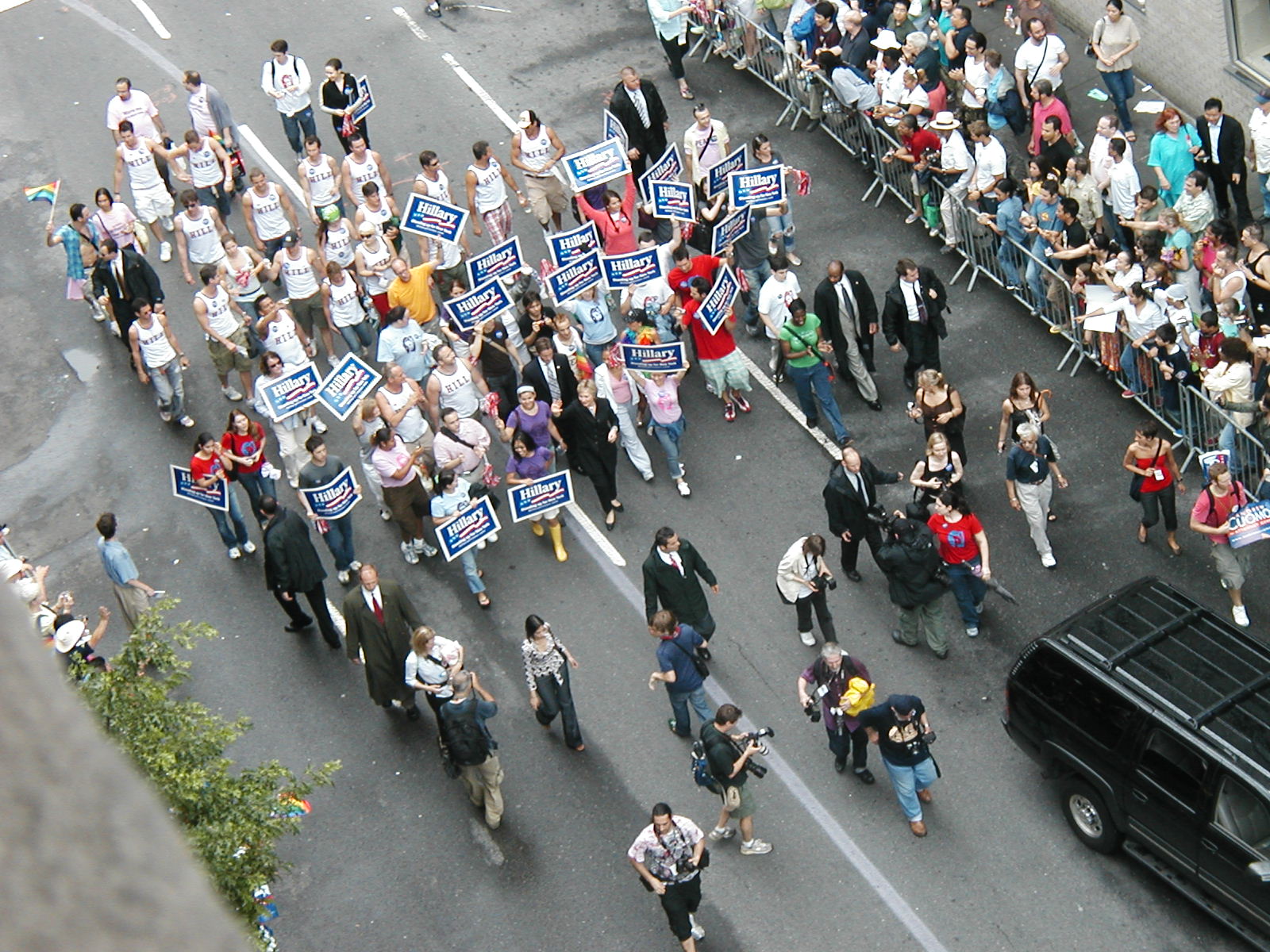
Here’s a question: Will Hillary Clinton march in the New York City gay pride parade in a few weeks?
She’s marched in all the other NYC gay pride parades since she became Senator from New York (I took this picture of her from our apartment window two years ago). Except for last year. Last year she was too busy running for president, and marching in New York City’s gay pride parade probably didn’t seem like the best way to appeal to a national voter base.
But now she doesn’t have to deal with that anymore. So I wonder if she’ll march. She’d probably have a ginormous crowd.
“The night before the burial of her husband’s body, Katherine Cathey refused to leave the casket, asking to sleep next to his body for the last time. The Marines made a bed for her, tucking in the sheets below the flag.”
This and the photo got my tears going.
Video: A look back at the Clinton campaign. Nice summary of the past five months — er, year and a half.
I love watching this analysis of Obama’s 2004 convention speech. A star is born.
Hilarious. I love the line about the Marx Brothers.
[via Tim]
Classy.

Also classy.

That’s what I like seeing.
Some interesting tidbits from this extended piece on the Clinton campaign.
Bill Clinton:
While riding with Mr. Clinton in his car to an event, [Congressman] Altmire said, he asked how Mr. Obama’s learning curve at the White House would stack up with that of the former president, who was 46 when he took office. “I made a lot of mistakes when I started out,†Mr. Clinton replied, according to Mr. Altmire. “And I did some things in office that were politically naïve, and I would have a fear that Senator Obama would have the same experience.â€
Mark Penn:
Election night [in Pennsylvania] brought home the varied complex personal and political dynamics at play. Mr. Penn, once the most influential voice in the Clinton universe, showed up at campaign headquarters outside Washington to watch the returns but virtually no one would talk with him and he left early.
Terry McAuliffe:
Mr. McAuliffe served as morale officer, regularly visiting headquarters and taking dejected aides to dinner. His feisty, manic television appearances became so ubiquitous that aides developed “Terry Bingo†with 25 boxes listing his most common lines of spin — “More electable,†“Can still win†— and marked the boxes as he uttered them again and again.
Most interesting of all, Elizabeth Edwards:
Mrs. Clinton’s elation at each new victory was stemmed by some painful new setback. She crushed Mr. Obama in West Virginia. But as she celebrated, Mr. Obama upstaged her by appearing in Grand Rapids, Mich., the next day with a surprise endorser, former Senator John Edwards.
Mrs. Clinton noticed, however, that Elizabeth Edwards did not join her husband. Mrs. Edwards in recent months had grown to like Mrs. Clinton, an Edwards adviser said, and so the campaign reached out to see if she might back the New York senator.
Mrs. Edwards would not go that far.
Justice Scalia is a fan of “Sex and the City.”
Apparently Antonin Scalia is a Sex and the City fan. When Sarah Jessica Parker finished an interview with Charlie Rose on May 29, she left the Bloomberg Building, where the show is taped, and stopped for a cigarette in the courtyard. The conservative Supreme Court justice emerged from a nearby Town Car and rushed over to praise the star. “He was absolutely gushing, telling her how much he loved her show and how excited he was to see the movie,†says a witness. “Finally, he asked her if he could bum a cigarette.†She obliged, the witness said, and then Scalia strolled away. A Supreme Court spokeswoman confirmed the meeting but denied the cadge. “He was there for a symposium,†she said. “And he lent her a match.â€
I’m cranky today.
It’s hot as hell outside. It’s around 100 degrees here in Newark, where I work. Newark is usually a couple of degrees hotter than Manhattan — the disadvantages of not being an island.
It’s been like this since Saturday and it’s not supposed to break until Wednesday. Of course I picked yesterday to go to the gym for the first time in eight months. I spent 30 minutes on the elliptical and then trudged 13 blocks home… very… slowly. I was just zonked. Sapped of energy.
We had enough foresight to buy an air conditioner for our new apartment a few weeks ago and get it installed. So that’s good. But there’s an air conditioner in the apartment two floors above us, in the exact same window. I realized this on Saturday, when it started dripping onto our air conditioner. Water dripping onto metal from two floors up makes a racket. It’s like a drippy faucet but three times as loud. It actually woke me up around 4:30 this morning. We sleep with our bedroom door open, because the A/C is in the living room.
I haven’t had a good night’s sleep on a weeknight in more than a week. We decided to rearrange our bedroom last week, but it was really bad feng shui. My head was right next to the bedroom door. I mean right next to it. So we put the bedroom back the way it was. But I’m still not sleeping well. Maybe it’s because we don’t actually have a bed. We just have a mattress. We really should get a bed. At the very least, a boxspring. And maybe a new mattress. And I don’t like sleeping with the bedroom door open. I like feeling like the bedroom is sealed off from the living room.
If it’s not one thing with this new apartment, it’s another.
Now that the Democratic nomination has been decided, politics seems less pressing. There’s less of a need to click on Talking Points Memo 10 times a day. No weekly primaries to anticipate or results to parse. No reason to talk about superdelegates.
What a letdown! And a relief.
I was playing around with Google Street View yesterday and realized that they’ve expanded their coverage of the New York City metropolitan area. (It turns out that they just added the new streets a couple of days ago.) You can now see every street in the five boroughs — Manhattan used to be the only borough with complete coverage, with just main highways covered in the other boroughs. You can also see some main streets in parts of New Jersey.
So yesterday I looked at the homes where both sets of my grandparents lived when I was growing up. (They both lived in different parts of Queens.) I also looked at the two-family house in Queens where we lived until I was three years old, before we moved to New Jersey. And I also looked at my NJ hometown. I could see my house, since it’s right near one of the streets with coverage.
I continue to be amazed by Google Street View, and by how it can evoke emotional responses in me just by letting me look at buildings I haven’t seen in years. Or even just a few weeks ago.
Tim Russert has apparently died. Both the New York Times and the New York Post are reporting that he died today at 58 of a possible heart attack.
I’m stunned.
Update: Tom Brokaw now live on MSNBC announcing it. He died in the NBC News bureau in Washington.
“Our issues this Sunday…”
About four years ago, I started watching “Meet the Press” every Sunday morning. I hadn’t always done so, but after I got a TiVo I decided to record it every week, and I became a regular viewer. Since then it’s been a ritual to turn on the TV every Sunday and hear that agitated John Williams music, followed by Tim Russert’s portentous introduction to the past week’s events. And MSNBC was my network of choice during this primary season, so I’d often hear Keith Olbermann and Chris Matthews turn for analysis to “NBC News Washington Bureau Chief and Moderator of Meet the Press Tim Russert,” as Homeric an epithet as “wine-dark sea” or “rosy-fingered dawn.”
It’s weird to think that he’s gone. It’s weird to think that he won’t be here for the rest of this election season. He won’t be there to analyze the vice-presidential picks, or the conventions, or the debates, or the results on election night. Never again will he grill a politician about whether he’s going to run for president even though he’s already said no four times, never again will he awkwardly read a newspaper excerpt that takes up four screens’ worth of text, screwing up every tenth word. Never again will he interview John McCain or Doris Kearns Goodwin or James Carville or Gwen Ifill. He’s just… gone.
I didn’t always like Tim Russert, but I usually did, and I always admired him. I was off from work today and watched MSNBC most of the afternoon, and commentators kept coming back to his work ethic. Saturday nights were off-limits for him, as he always had to prepare for Sunday morning. He loved what he did and was good at it, and he cared about other people. These are all qualities I want to better cultivate in myself.
Here’s part of a transcript from an SNL skit a few years ago in which Tim Russert (played by Darrell Hammond) interrogates John McCain (played by John McCain) on whether he’ll run for president in 2004.
Tim Russert: Alright. Senator, I want to read you a quote… from the Washington Post… October 2nd, 1999: “I am a candidate for President of the United States.” Your word, Senator.
Sen. John McCain: Well, Tim, that’s from the last election, when I was a candidate.
Tim Russert: So, you’re flip-flopping?
Sen. John McCain: I’m not flip-flopping, Tim.
Tim Russert: So, you’re a candidate? We can definitively say, on this show, that John McCain–
Sen. John McCain: I was a candidate in 2000. I am not in 2004. I will not challenge President Bush as a leader of my party.
Tim Russert: What if President Bush does not run?
Sen. John McCain: I don’t see any reason–
Tim Russert: What if he forgets to run?
Sen. John McCain: Alright, Tim… alright, Tim…
Tim Russert: The President forgets to run for re-election… and the Republicans are without a candidate. Does John McCain then step in to fill that void?
Sen. John McCain: I would call the President, and remind him to run.
Tim Russert: So, you’re running?
Sen. John McCain: No!
I’ll miss that ol’ pumpkinhead.
Our company has consolidated our office space in order to save money. We’ve been condensed from three floors of an office building down to one and a quarter floors. I got downgraded from an office to a cubicle, because there aren’t enough offices for someone of my low seniority level to have one.
It’s kind of a bummer. I don’t think I’d have minded as much if I’d always been in a cubicle here, but it’s different when you’ve had an office for a year and a half and then you have to switch to a cubicle.
Goodbye to being able to close my door, goodbye to having a window, goodbye to being able to take quick naps underneath my desk. Hello to ambient noise, hello to other people being able to see what’s on my computer screen when they walk past.
Well, at least cubicles have walls. So, there’s that.
I was just listening to Debbie Gibson’s “Only in My Dreams” on my iPod. That song always makes me think of California. It takes me back to being 14 years old in 1988 and wanting to go there.
When I was 14, I had never left the East Coast. I’d been to Florida three times — one time my family drove down to Disney World, staying overnight in Savannah, Georgia — and I’d been to New England several times. But I’d never been off the East Coast.
That was going to change during the summer I was 14. The camp I’d gone to in New Hampshire for the previous two summers, Interlocken (which has since changed its name), had several short-term programs where you’d travel around different parts of the country, or even parts of other countries, for a few weeks — a dozen kids, two trip leaders and a van, mostly staying at campsites. I was going to go on the California trip. We’d start in San Francisco and travel in a big circle around northern California for four weeks. We’d visit Mendocino, drive up the coast, see the Redwoods, hike Mount Shasta, go whitewater rafting on the Klamath River, check out Lassen National Volcanic Park, stay with migrant families, and do other things before spending the last few days of the trip in San Francisco.
At the end of the trip, my parents and my brother were going to fly out and meet me in San Francisco, and we’d spend the next week and a half driving down the California coast, stopping at different places along the way: Santa Cruz, Monterey, San Luis Obispo, Solvang, Santa Barbara, Los Angeles, and finally San Diego.
I was so excited whenever I thought about the upcoming trip. What made it even more exciting — and here’s where we remember that I was a proto-gay adolescent — is that I was obsessed with “Days of our Lives,” and I knew it was taped in L.A. I couldn’t believe I was going to be in the same state as Steve and Kayla. Not to mention practically everyone else who was on TV. I know it seems weird to be excited merely to be going to the same state as these people, since California is so enormous that you can be there and still be hundreds of miles from Hollywood. But the idea of California was so magical to me that just the anticipation of being in the same state as these people made my heart race with happy nervous energy.
I’d lie in my bed in New Jersey at night and figure out which way was southwest. If I look at that wall, I’m looking southwest… so if I just extend this line for another 3000 miles, in a sense I’m really looking at California, and Kayla and Steve, and all of Hollywood…
I don’t know why I associate “Only in My Dreams” with that time. Maybe it came on the radio one day while I was thinking about the trip. Maybe the music just sounds like southern California to me, particularly the saxophone bridge. It just sounds so peppy and upbeat and 90210-ish. Who knows why music makes us think of certain things.
All I know is, I miss that feeling of anticipation, that excitement — I miss being naive enough to think that merely being in the same state as Kayla and Steve would bring something to my life, would change me in some way, would make my life that much more exciting — would make my life that much better.
Some Virginia conservatives are worried about what gay marriage in California might do. It might… get other people used to the idea!
Moore and Lux had never heard of West Hollywood. Only [George] Takei was a familiar face – but the notion that Mr. Sulu was now something of a gay activist just made matters worse.
“You watch this celebration, and I honestly worry about indoctrination,” Lux said. “It’s like the frog in the water syndrome,” Moore added in agreement. “You know, the frog doesn’t realize the water around it is heating up until it’s boiled. I worry that Americans will get used to these images and they’ll throw up their hands and say, ‘Who cares?’ â€
You mean they’ll see gay couples getting married and they’ll realize that it doesn’t cause any harm?
Wow. I actually agree with them. Except replace “worry” with “hope.”
Their argument against gay marriage has been reduced to “we can’t allow it or else people will be okay with it.”
They are intellectually bankrupt.
I’m in between books and it’s one of the worst feelings I know. I love having a book to read, but I get picky. I wander among the aisles and tables of the Strand, and I go to the library, and I browse on Amazon, and nothing appeals to me. I wind up having so much trouble finding a book to read that I begin to wonder if I only like the idea of having a book to read.
It’s like I have an itch and can’t figure out how to scratch it.
In the last few years I’ve given up on fiction and have been reading a lot of history. But yesterday after work I was at the Strand and thought it might be nice to read a novel for a change. The only problem is that I don’t know what novel to read. I keep looking for something that grabs me on the first page and I can’t seem to find something that I know will keep my interest for 200+ pages.
Maybe this ask.metafilter thread will help me. Or maybe this is just a hopeless task.
According to the New York Times, some people at NBC were annoyed that Tim Russert’s death showed up on his Wikipedia entry before NBC could notify everyone in his family.
Looking at the detailed records of editing changes recorded by Wikipedia, it quickly emerged that the changes came from Internet Broadcasting Services, a company in St. Paul, Minn., that provides Web services to a variety of companies, including local NBC TV stations.
An I.B.S. spokeswoman said on Friday that “a junior-level employee made updates to the Wikipedia page upon learning of Mr. Russert’s passing, thinking it was public record.†She added that the company had “taken the necessary measures with the employee and apologized to NBC.†NBC News said it was told the employee was fired.
Fired? For updating a Wikipedia page with true information? That seems excessive. Still:
One of the principles of the site is No Original Research — every fact must have appeared somewhere reputable before it can be repeated. (This cause can seem an obsession as stickler editors patrol the site flagging unattributed facts with the label “citation needed.â€
Here’s the Wikipedia page on the “no original research” policy, if anyone wants to check it out.
I guess it makes sense that you should be able to cite a source. But what if the employee had a citable source? If the employee was truly fired, presumably it’s not because the employee violated a Wikipedia policy but because the employee posted true information on Wikipedia before the network wanted it to.
The New York Post was apparently the first news organization to report Russert’s death — only about 20 minutes after someone first updated Wikipedia. So an employee was fired for updating Wikipedia 20 minutes before the news went public.
The New York Post itself broke the news about 20 minutes before NBC publicly announced Russert’s death. So did the New York Times. Did the Times or the Post verify that all of Russert’s family members had been notified before they posted the news? If not, has anyone been fired at those organizations?
In the internet era, it seems wrong to fire someone for revealing information 38 minutes before the news “officially” breaks. Whatever “officially” means in this context. Granted, I’d hate to find out about a close family member’s death through Wikipedia (not that I can imagine that happening — I don’t have any famous relatives). But… I don’t know. This just doesn’t seem right.
After trying to decide what to read, I wound up buying Everything is Illuminated by Jonathan Safran Foer. Yeah, I missed that hipster train by about six years, but I figured better late than never. I prefer to read amazingly-reviewed novels when they’re new, or at least when they’ve just come out in paperback. As for the other kinds of books: if I see one more 20- or 30-something woman reading Eat, Pray, Love on the subway, I’m gonna hurl. For all I know, it’s an excellent book. I just can’t stand to see it anymore.
So — I started Everything is Illuminated last night and I’m 20 pages into it.
Does it get better?
Maybe I’m in the wrong mood for it, but it seems to be trying a bit too hard. Or maybe I’m just over pomo fiction. Maybe I should have picked something with more conventional prose. I was going to read Arthur and George. If this book doesn’t pan out, I may pick that one up.
Or maybe I just need sleep. I feel rotten today. We went to bed at midnight last night, but I woke up at 3:30 in the morning and couldn’t get back to sleep. Got out of bed, got back into bed; repeated a couple more times. It didn’t help that the sun was rising by 5 a.m., since it’s the fourth-longest day of the year. (The solstice was on Friday!)
I was going to stay home today and try to sleep, but I still couldn’t sleep, so after two hours I gave up and came into the office, because the idea of sitting alone at home on this dark and cloudy day, feeling droopy, with nothing to do and nobody to talk to, filled me with dread.
In the last few weeks I’ve woken up in the middle of the night more frequently than usual. It tends to happen around 4:00. I wonder if it’s a sign of depression or a sign that I need new pillows or that we need a new mattress — or an actual bed, since we don’t actually have one. (Wow, look at the nested structure of that last sentence.)
Zzzzzzzz…
Everything is Illuminated is growing on me. I followed this advice. The book has its charms, and it also helps to be reading it when you’ve had more than three and a half hours of sleep.
I think my body’s making up for not getting much sleep the other night, because I’ve been having vivid dreams lately.
Last night I dreamed that my brother and I were riding a New Jersey Transit train into Manhattan. The train was moving slowly and we weren’t sure way. Then the train stopped, and some ticket-takers came down the aisle and told us that it was a hijacking. We saw that they had guns. One of them walked down the aisle carrying a big garbage bag and asked everyone to empty the cash from their wallets into it.
I took out my wallet and removed the cash — several twenties — and put it in the bag. I realized I still had a dollar bill left in there that the guy hadn’t seen, and I was going to keep it, but then I thought better of it and took that out too.
Then my brother, being a badass, pressed a very visible silent alarm button. It was above the seats, just like the “request stop” button is on buses. He pressed it for several seconds. I was sure he was going to get shot, but nothing happened.
Then the crew was done robbing us, and they drove the train down a side track. It stopped on a street corner in a country neighborhood so we could get off. Tall trees, overgrown grass, a house at the corner. We all jumped off the train in a civilized way, but my heart was racing and I couldn’t wait to get away from there.
Later in the dream, someone told me that I was expected at the police station, where I was supposed to recount my story about what had happened. But I knew that the policemen were in league with the train crew and I refused to go, because I thought they were going to do something bad to me.
I guess authority figures scare me?
I also dreamed that the news media reported that Joe Lieberman had died while on a trip in Afghanistan, and I was glad, because he wouldn’t be able to help McCain anymore or speak at the Republican National Convention.
A couple of weeks ago, Justice Scalia, in dissenting from the Supreme Court decision stating that Guantanamo detainees have habeas corpus rights, lamented that the ruling “will almost certainly cause more Americans to be killed.”
Today he wrote an opinion finding a broad right to own handguns, a decision that, one could argue, “will almost certainly cause more Americans to be killed.”
Maybe, maybe not, but thanks to Slate for pointing out the contradiction. If it is one.
I don’t know whether the ruling is correct or not. The opinion and two dissents run to more than 150 pages, and they’re unusually chock-full of scholarly, historical analysis. And we’re talking about a sentence that was written more than 200 years ago in a vastly different world with vastly different writing styles and vastly different guns.
This is what happens when you try to interpret one of the world’s oldest functioning constitutions. Do other countries, with newer constitutions, have this problem? Do other countries’ judges have to interpret such sentences as, “A well regulated Militia, being necessary to the security of a free State, the right of the people to keep and bear Arms, shall not be infringed”? Let alone the crappy sentence structure, what do the individual words mean?
It’s worth noting that the D.C. law at issue was pretty extreme. It banned the possession of handguns in your own home, and all other types of guns in your home had to remain either unloaded and dissassembled or bound by a trigger lock or similar device. The majority opinion has narrow effect — it strikes down this law, but it doesn’t discuss other types of gun laws, including that prevent criminals or the mentally ill, etc., from having guns.
Scalia ends his opinion as follows:
We are aware of the problem of handgun violence in this country, and we take seriously the concerns raised by the many amici who believe that prohibition of handgun ownership is a solution. The Constitution leaves the District of Columbia a variety of tools for combating that problem, including some measures regulating handguns… But the enshrinement of constitutional rights necessarily takes certain policy choices off the table. These include the absolute prohibition of handguns held and used for self-defense in the home. Undoubtedly some think that the Second Amendment is outmoded in a society where our standing army is the pride of our Nation, where well-trained police forces provide personal security, and where gun violence is a serious problem. That is perhaps debatable, but what is not debatable is that it is not the role of this Court to pronounce the Second Amendment extinct.
What happens if we change a few words?
We are aware of the problem of terrorism in this country, and we take seriously the concerns raised by the many amici who believe that the stripping of habeas corpus rights is a solution. The Constitution leaves the government a variety of tools for combating that problem… But the enshrinement of constitutional rights necessarily takes certain policy choices off the table. These include the stripping of habeas corpus rights except in times of rebellion or invasion. Undoubtedly some think that the right of habeas corpus is outmoded in a society where the threat of terrorism is a serious problem. That is perhaps debatable, but what is not debatable is that it is not the role of this Court to pronounce constitutional rights extinct.
Who’s right?
Who knows?
Isn’t Supreme Court analysis fun?
The problem with constitutional interpretation is that we often confuse the question of what the law should be with the question of what the Constitution says the law is. Non-lawyers often confuse their policy preferences with constitutional interpretation. Actually, legal scholars do it too. Otherwise there would be no such things as 5-4 Supreme Court decisions.
Therefore, when you take a complicated issue, such as gun control, where there are decent arguments on both sides, and you throw in the task of trying to interpret a constitutional provision that is both (1) written in eighteenth-century language and (2) confusingly worded even for the eighteenth century, it’s easy to throw your hands up and say, “How the hell do I know?”
That’s what I sometimes do.
I recently finished reading Sean Wilentz’s new book, The Age of Reagan: A History, 1974-2008. It’s about the rise of the conservative movement from the post-Watergate era to the present, with its culmination in the Reagan presidency.
I didn’t notice this right away, but it eventually struck me that the era covered in The Age of Reagan coincides almost exactly with my lifetime. I was born in December 1973, at the height of Watergate. I was an infant when Nixon resigned. I used to think I was a “Watergate baby,” until I learned that the term “Watergate babies” actually refers to the 75 Democrats elected to Congress in 1974 in the wake of the scandal. But I still like applying the term to those of us born around that time. I feel some solidarity with people who are my age or pretty close to it, who were in the same grade of school at the same time as me, who experienced world events at the same age I did.
It got me wondering about when I first discovered “the news.” What’s the first news story I remember?
I think it was the Iranian hostage crisis. I remember sitting in my parents’ bed one morning in the late ’70s. On TV there were men with white hoods covering their heads. This was a striking image for a little kid to see, and it scared me. Did I see something similar to this?
The next news event I remember is the 1979 gas shortage. My mom packed me into the car with some sandwiches on a spring (summer?) day and we drove to the nearby gas station, where we waited on a long line that stretched around the block, everyone waiting to get gas.
Next: the 1980 election. I remember being in my first grade classroom and looking at the latest edition of the Weekly Reader, the weekly newsmagazine for kids. On the cover were pictures of the three major presidential candidates, each in an oval: President Carter, Ronald Reagan, and John Anderson.
Next I remember the 1984 election. In my fifth grade classroom, we had a mock vote. One student portrayed Reagan and the other portrayed Mondale, and each articulated the candidate’s positions. Then we voted. Out of 20-plus kids in the class, everyone voted for Reagan except me. I voted for Mondale.
From then on, I started to become more aware. Live Aid. The Challenger disaster. Chernobyl. Iran-Contra. The 1988 election, where every candidate seemed to have a one-syllable name. (Bush. Dole. Gore. Hart. Haig. Kemp.)
What are the earliest news events you remember?
Well, that was fun!
My apologies to anybody who’s tried to access my site since Friday. My site’s been down for four days and it finally came back up this evening. I ran into a little snafu while trying to renew my domain name. It was frustrating. But things seem back on track now.
If you’ve sent emails to me at tinmanic.com since Friday, I haven’t received them. So you might want to try sending them again.
Again, my apologies, and I’m just glad my site’s back up.