
“Joey” and “Jack & Bobby” have both been picked up for the entire season. They’re the first new shows this year to be promised a full year’s run.
Monthly Archives: October 2004
Canyon of Heroes II
A few weeks ago I blogged about the Canyon of Heroes markers in lower Manhattan. Before learning what the markers were for, I had e-mailed LowerManhattan.info to see if they knew the answer. Well, I just got the following e-mail:
We appreciate your contacting us with this question and are happy to inform you that we used your question as LowerManhattan.info’s “Question of the Week.†To find the answer to your question, please visit [here].
Yay!
Coincidentally, this ran in the New York Times yesterday.
The First Debate
My opinion of the debate in four words: much better than Gore.
(But first, Matt and I both loved the moment at the end when Laura Bush and Teresa Heinz Kerry warmly greeted each other and compared their similarly-colored dresses. Actually, we were hoping for a Krystle/Alexis catfight.)

Anyway, here are my thoughts, which don’t matter anyway, because the Borg Media Collective will form its own narrative over the next two or three days, probably with the help of some agile Republicans, and transmit it to the masses. But here goes.
First, Kerry’s face wasn’t orange. That alone was an improvement over Gore. On top of that, he didn’t sigh or patronizingly shake his head, he didn’t sweat, and not once did he go over his time limit. And he sounded gracious in praising Laura Bush, which was a nice touch.
Bush was Bush. I loathe him, but I’m not a swing voter, so again, my opinion doesn’t matter. While he barely stumbled over words, some of his pauses were painfully long, and he certainly looked annoyed when the camera showed him listening to Kerry’s responses.
I’m glad Jim Lehrer helped them get into some real give-and-take a couple of times; it was far from the sterile “parallel press conference” I’d expected.
As for substance, I’m glad that more than once, Kerry emphasized the distinction between Osama bin Laden and Saddam Hussein.
KERRY: Jim, the president just said something extraordinarily revealing and frankly very important in this debate. In answer to your question about Iraq and sending people into Iraq, he just said, “The enemy attacked us.”
Saddam Hussein didn’t attack us. Osama bin Laden attacked us. Al Qaida attacked us.
. . .
BUSH: First of all, of course I know Osama bin Laden attacked us. I know that.
I think he meant to add you dumbass.
My favorite moment was this Bush line:
But to say that there’s only one focus on the war on terror doesn’t really understand the nature of the war on terror. Of course we’re after Saddam Hussein — I mean bin Laden.
That, in a nutshell, explains the entire Iraq fiasco.
There were a few times that Bush said something and I wanted Kerry to respond a certain way, but he didn’t. When Bush brought up the “$87 billion” thing, I wanted Kerry to explicitly explain that he “voted for the $87 billion” when it was going to be paid for by taxing the richest Americans, and then “voted against it” only because the bill itself changed — instead of being paid for in taxes, the $87 billion was going to be added to the deficit. But maybe that would have been too complicated for the American people to understand. Instead:
KERRY: Well, you know, when I talked about the $87 billion, I made a mistake in how I talk about the war. But the president made a mistake in invading Iraq. Which is worse?
Fine. Hey, I don’t know from politics.
Kerry was also nicely succint here:
I’ve had one position, one consistent position, that Saddam Hussein was a threat. There was a right way to disarm him and a wrong way. And the president chose the wrong way.
So I liked the debate. Again, though, ALL BETS ARE OFF as to how last night plays into the election, as I’m nobody.
He Forgot Poland!
Oh, and I forgot this, which Jon Stewart showed last night on “The Daily Show”:
BUSH: My opponent says we didn’t have any allies in this war. What’s he say to Tony Blair? What’s he say to Alexander Kwasniewski of Poland?
[moments later]
KERRY: Secondly, when we went in, there were three countries: Great Britain, Australia and the United States. That’s not a grand coalition. We can do better.
. . .
BUSH: Well, actually, he forgot Poland.
Don’t forget Poland!!!
To be fair, Bush then added, “And now there’s 30 nations involved, standing side by side with our American troops.” But it was still a lovely clip.
When George Meets John
When George Meets John: This is a really great read, although it was written a couple of months ago.
Beyond Debate
From the New Republic (more good stuff):
The first inkling that the Bushies know their man didn’t do so well comes minutes after the debate ends when Karl Rove walks into the press filing center. Like a game of telephone, the conventional wisdom that Kerry won the debate is already seeping out across the sea of journalists in the room. Into this skeptical ether, Rove tries out a line: “It was one of the president’s better debate performances and one of Kerry’s worst.” Vince Morris of The New York Post stares at Rove and asks, “Can you say that with a straight face?”
. . .
Bush demanded that those little warning lights be prominently displayed on the podium to embarrass Kerry when he delivered long-winded answers. The opposite happened. The tight time limits helped Kerry — always at his best when on deadline — control his message. Instead the lights served to emphasize that Bush didn’t always have enough to say to fill out his time. In previous debates Bush would sometimes answer a question with a short declarative sentence and a sharp nod of the head. The lights would have made this embarrassing, and at times Bush started repeating stock lines and seemed as though he were filibustering. The Kerry campaign used the lights brilliantly. Before the debate they even mischievously demanded that the lights be removed when in fact they knew they would help Kerry. “We protested too much on the lights and you all fell for it,” Joe Lockhart told me.
. . .
As for why Bush seemed so irritated, one explanation is that his efforts to cut himself off from criticism and tough questions have backfired. Perhaps his penchants for limiting press conferences and campaigning only among his most ardent supporters have lowered his tolerance for the kind of relentless challenging he faced during the debate.
. . .
Out on the stump where he can get away with it, Bush often campaigns against a caricatured version of John Kerry, a straw man who takes all sorts of radical positions. Bush’s problem last night was that he continued to debate that straw man instead of the person who actually showed up on stage.
I still fear that the Bushies are playing the expectations game, though. There are still two debates left; Kerry could get overconfident and Bush could come roaring back. We’ll see.
YouForgotPoland.com
That Internet sure is fast.
Kerry and Bush are Even
This Newsweek poll is heartening: post-debate, Kerry and Bush are now even. And the poll was conducted from September 30 to October 2, which means that some of the polling was done before the first debate even took place, so I’d bet the real number is slightly more in Kerry’s favor.
But I’m not throwing confetti yet. There are two debates to go. And here’s an anecdote from 1984 to keep in mind:
In his first debate with Walter Mondale, [Reagan] appeared positively befuddled against his opponent’s mastery of detail, and post-debate polls showed some concern about whether Reagan was, at 73, too old for office.
But when Mr Mondale sought to make this an issue in the second debate – Reagan swiftly retorted: “I will not make age an issue of this campaign. I am not going to exploit, for political purposes, my opponent’s youth and inexperience.”
In one fell swoop the Reagan voters liked had returned: confident, witty and presidential.
The incumbent screwed up the first debate, then turned it around and got re-elected.
Yeah, W is no Reagan, but things now stand where they were before the first Bush-Gore debate four years ago: Bush once more has a chance to rise above low expectations. And I hope Kerry isn’t overconfident, because the Bush people probably learned a great deal from Thursday night and are ready to apply it.
We shall see.
Matt and I Turn One
A year ago today, Matt and I had our first date. It wasn’t officially a date; it was meeting up for coffee in order to get to know each other after reading each other’s blogs for a while. The following week, he explicitly asked me out on a date. But in retrospect, the designation of first date belongs to that very first meeting.
I’d always wanted a long-term relationship with someone, but I wasn’t expecting it to happen when it happened. I guess that’s how these things work: you never know when you’ll meet that person, or how.
I’ve never met anyone else with whom I’ve clicked so well. We don’t even need to be doing something exciting; even if it’s just an ordinary day, and I’m sitting on his couch reading the Sunday paper while he types away at his computer, it’s so comforting to be around him. We joke that we’re like an old Jewish couple, making sure each other’s stomachs are feeling alright, sometimes yawning too early on Saturday nights. We just mesh.
Plus he’s so totally cute.
A few months ago, we were at a birthday gathering at a bar, sitting next to each other on a couch. We were being all cuddly, and then, seemingly out of nowhere, he said to me, “You know… we’ve never talked about the L word.”
I looked at him and said, in mock horror, “You’re a lesbian???”
We both cracked up.
We’ve said it to each a bunch of times since then. But just for the record:
Matt, I love you, and I’m so glad you’re my boyfriend. Happy one-year anniversary.
Clerkship Rejection Letter Template
Here’s a rejection letter template for judges to send to clerkship applicants.
Richard Avedon Slideshow
An appreciation of Richard Avedon, who died last week, including a slideshow of some of his New Yorker photos.
Marshall Wittman Endorses Kerry
Marshall Wittman, — John McCain’s former communications director, former member of the Christian Coalition, and self-described “Bull Moose” progressive — endorses John Kerry in a must-read, wide-ranging indictment of the Bush administration. He slams the leaders of the religious right; the attempt to repeal the estate tax; the Bush administration’s handling of Osama bin Laden, Afghanistan, and Iraq, its conduct during the 2002 mid-term elections, and its hypocrisy on “accountability”; and Bush’s lack of true conservatism. He says of Kerry:
Although I had my differences with Kerry during the Cold War, he has demonstrated by his hawkishness on Kosovo and Afghanistan that he is willing to use force to defend American ideas and interests. He advocates increasing the size of the U.S. military. On domestic issues, Kerry has positioned himself in the New Democrat tradition. Kerry has proposed an ambitious national service program. He would retain the tax cuts for the middle class while rolling them back on the super-rich. And he would reform, rather than eliminate, the estate tax.
. . .
Bush and Vice President Dick Cheney have waged an unprecedentedly cynical and divisive campaign. The campaign has proven that there are no guard rails when it comes to a scorched-earth effort to hold on to power. However, Democrats can seize the opportunity to reach out to disaffected moderate Republicans and independents to build a new political coalition of national unity. That is both the hope and the cause of this unreconstructed Bull Moose.
It’s worth a read.
Columbus Day Weekend
Tomorrow morning, at the crack of dawn, Matt and I are flying down to southeastern Tennessee for Matt’s brother’s wedding. I’ve met Matt’s mom before, but now I’ll get to meet the rest of the family. I’m a little nervous about it, but I’m sure it will be great, and at any rate, it’ll be nice to get away for a few days.
See you next week!
Weight
We’re back from Tennessee.
I’ll write all about it, but first, I can no longer deny the obvious.
I have gained weight.
I never gain weight. Weight gain is as foreign to me as, say, sickle cell anemia. It’s just something I’ve never had to worry about. I have a big appetite, and I’ve always been able to eat as much as I wanted to while staying thin.
I’m not talking about a lot of weight here. I’m still at a healthy weight for my height. But I can no longer fit into the 29-waist jeans I bought last December. I remember wearing them comfortably at one point this summer, even. But a couple of weeks ago, I tried to button them and I could barely breathe. So I went out and bought a pair of 32 jeans, which fit me comfortably, if a little loosely. Wearing 32-waist jeans is not unprecedented for me, but it’s been a long time since I’ve needed them.
I’ve weighed myself on two different scales in the last few days, and sure enough, I appear to have gained 10 pounds since the last time I weighed myself. A year, year and a half ago, I was actually down to 125 pounds, which had surprised me, since I’d normally been around 130. (I’m just under 5’6″.) But now I seem to be weighing in at 139 or 140.
I don’t know what’s causing this. It could be the Celexa I’ve been taking for a year. It could be all the eating out Matt and I have done. It could be the effects of age (I’m 30 now, and maybe my metabolism has slowed). I hope it’s not the latter, because that would be something I’d just be stuck with.
All I know is, I’ve never had to exercise or watch what I eat in order to stay thin. I guess I’ll just have to start.
Sigh.
R.I.P. Christopher Reeve
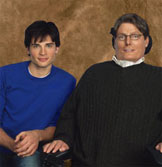
I always thought he’d walk again. I really did. His optimism was that palpable, especially as conveyed in the profile that ran in the New Yorker last year.
His accident happened near the University of Virginia less than a week after I graduated from there. He spent some time at the UVa Hospital, and then he went to the Kessler Institute, which is in West Orange, New Jersey, the next town over from my hometown. A few years later, when I was back at UVa, I saw him give the Valedictory Address during graduation weekend. Just last month, my mom got to attend a lunch where he was speaking.
He appeared twice on “Smallville” as Dr. Virgil Swann, a doctor who introduced Clark to his Kryptonian heritage; I wonder if any future appearances were planned. If so, maybe they’ll use Margot Kidder instead, who was on the recent season premiere as Dr. Swann’s colleague.
I can’t imagine what the last nine-plus years must have been like for him and his wife. I don’t know what I would have done in his circumstances. I hope his wife, at least, can find some measure of peace now.
I’m still sad that he’ll never walk again.
Tennessee Wedding
Where do I begin describing our trip to Tennessee last week for Matt’s brother’s wedding? I had such a great time. Here, in random order, are some vignettes.
I’ve never met three siblings more completely different than Matt and his two brothers. The youngest, Andrew (the groom), is a self-described redneck. He’s scruffy-looking and rides a motorcycle. (I didn’t see much of him since he was busy most of the time with wedding stuff.) The middle brother, Gary, is a jack of all trades. He’s incredibly nice and very funny, with a quick wit and oversized glasses. He looks a little like Matt. He went to welding school and now works at Lowe’s. He brought his dog for the weekend, a collie/mutt named Rosie, and she reminded me so much of my family’s old dog. (I would have taken her home with me if I could have snuck her on the plane.) Then there’s Matt, of course, who’s gay, lives in New York, and loves musical theater. I would never think that he was the brother of these guys. On the other hand, he loves to tinker with computers, so I guess the three of them have a love of tinkering in common.
Matt’s father and uncle were born in Roswell, NM in the 1940s. Both men believe there could have been aliens in Area 51. Matt’s uncle described some conversations with people who worked at the base, and Matt’s dad speculated that transistors might have come from alien technology. I couldn’t tell how seriously they believed in it, though.
I went to my very first Steak n Shake. Yum. I’d never heard of it before, which is no surprise, given its locations.
Matt, Matt’s mom and I shopped at the biggest Wal-Mart I’ve ever seen. It was cavernous.
College football is huge in the South. I went to school in Virginia, but someone joked with me last weekend that Virginia isn’t really the South. After the wedding reception on Saturday, Matt and I wound up watching the end of a Tennessee-Georgia football game with a bunch of middle-aged men in the living room of Matt’s parents’ house. The few times that someone addressed a sports-related comment to me, I nodded and smiled and pretended I understood.
Andrew’s childhood friend was at the wedding. He goes to Auburn. He mentioned that his best friend at Auburn is gay, and that the guy’s fraternity kicked the guy out when they learned this, except that they wanted him to stay long enough so that they had enough brothers to qualify for something-or-other. Nice work.
There’s so much open country. Standing on the steps of the church, one could look out and see
green mountains in the distance. Barely any vehicles going by. Quiet and beautiful.
I saw more political signs on front lawns than I’d seen in a long time. A majority were Bush-Cheney, but there were more Kerry-Edwards signs than I’d expected.
The bride’s parents had incredibly thick southern accents. “Like” was “laaaahk.” Each of her two brothers had intriguing facial hair and two earrings. (Matt told me that earrings don’t mean the same thing down south as they do in New York.) They both ushered at the wedding, but they wore their shirts open-necked and with no tie.
The men in the wedding party wore white tuxes and white shoes.
I was slightly thrown off the southern stereotypes by the wedding being Catholic, not Baptist or anything like that.
The priest definitely seemed to know what the deal was with me and Matt. Interesting.
The room where we slept had the 1981 World Book Encyclopedia on its shelves. I had fun poring over it.
On the way back to the airport, Matt’s dad gave us a driving tour of nearby Chattanooga and the surrounding area. I like seeing parts of the country I’ve never seen before.
Again, I had a great time. I’m glad I went.
More as it occurs to me…
The Third Debate
Frank Rich says we’ll need another Woodward and Bernstein if Bush is re-elected.
You know, as much as I want Kerry to win, a very small part of me hopes Bush wins, if only because I want him to have to clean up his own mess in Iraq. If things are going to be shitty in Iraq no matter who wins, we may as well make him deal with it himself. On the other hand: 1) his power of denial is astonishing, and he probably won’t clean up his mess, nor appear to care about it, and 2) the small bit of satisfaction gained in watching the public turn against him will be outweighed by having to deal with him for another four years, wth the public powerless to kick him out.
I’m bummed that the polls seem to be stuck in a tie, but at least that’s better than Bush’s clear lead before the debates. Still, I’m dumbstruck by what Bush gets away with. He outright lied last night when he said, “Gosh, I just don’t think I ever said I’m not worried about Osama bin Laden. It’s kind of one of those exaggerations.”
No it’s not, dipshit. From March 2002:
Q: But don’t you believe that the threat that bin Laden posed won’t truly be eliminated until he is found either dead or alive?
THE PRESIDENT: Well, as I say, we haven’t heard much from him. And I wouldn’t necessarily say he’s at the center of any command structure. And, again, I don’t know where he is. I — I’ll repeat what I said. I truly am not that concerned about him. I know he is on the run.
And those words from 2002 weren’t just a verbal gaffe. He didn’t just say he wasn’t concerned; his subsequent actions showed he wasn’t. He didn’t care about finding bin Laden as much as he cared about using 9/11 as an excuse to get rid of Saddam.
There was also Bush’s lie last night that “my opponent says he’d give other nations a veto over national security” or whatnot, when Kerry has repeatedly and quite directly said that he won’t. Again, I’m amazed. I wish Kerry had made more of a character issue out of this kind of thing. There was a lot of “he said/he said” last night; Bush would say something and Kerry would respond with his version of things, leaving the viewers to wonder who was right. Kerry should have tied it all together and made a global argument, saying, “This is a president who hears only what he wants to hear, who has shown time and again that he’s completely out of touch with reality,” and so on. He should have exploited the instincts people already have about Bush. But perhaps he thought that would sound too mean-spirited when he’s trying to win over more women.
So, here we are: 19 days to go, the polls are tied, and unless something changes (and I’m sure the Bush people have a few tricks up their sleeves), November 2 is going to be one long night.
In fact, November might be one long month.
The West Wing
“Will ‘The West Wing’ go Republican?”
“We were a year and a half into the administration when we started the show,” Wells said of the NBC drama entering its sixth season. “We have term limits in this country and so, on our electoral schedule, Bartlet’s second term would end a year from this coming January.”
What the heck is John Wells talking about? We were less than a year into the administration when the show began, and the second term would end two years from this coming January. “The Midterms,” in which the midterm congressional elections took place, aired in the fall of 2000, and more importantly, Bartlett won re-election in the fall of 2002 and had his second inaugural in January 2003.
And here’s a “West Wing” timeline if John Wells needs any help.
I hate, hate, hate it when TV programs do this sort of thing. Someone better correct him, fast.
Mary Cheney
So, there’s this artificial tempest going on because Kerry referred to Mary Cheney as a lesbian during the third presidential debate.
If you haven’t been following, some people (particularly Lynne and Dick Cheney) claim that it was unconscionable for Kerry to bring up Mary Cheney’s homosexuality during the debate, after moderator Bob Schieffer asked if the candidates believe homosexuality is a choice.
KERRY: We’re all God’s children, Bob. And I think if you were to talk to Dick Cheney’s daughter, who is a lesbian, she would tell you that she’s being who she was, she’s being who she was born as.
I think if you talk to anybody, it’s not choice. I’ve met people who struggled with this for years, people who were in a marriage because they were living a sort of convention, and they struggled with it…
Lynne Cheney called Kerry “not a good man” and said mentioning Mary was a “cheap and tawdry political trick.” Dick Cheney described himself as “a pretty angry father.” The New York Post (big surprise) has it as today’s cover story under the headline “NO SHAME.”
Oh, I see. So it’s okay for you to mention your own gay daughter, but nobody else can?
Cheney’s remarks came in response to a question from a member of the audience at an Aug. 24 town hall meeting in Davenport, Iowa.
The audience member asked, “I would like to know, sir, from your heart — I don’t want to know what your advisers say, or even what your top adviser thinks — but I need to know what do you think about homosexual marriages?”
With his wife Lynne Cheney sitting next to him, Cheney said, “Lynne and I have a gay daughter, so it’s an issue that our family is very familiar with.”
No, it can’t be that it’s okay only if it’s your own daughter, because the Cheneys didn’t express public outrage when Republican Senate candidate Alan Keyes referred to Mary recently as a “selfish hedonist.”
This is utter bullshit. Karl Rove must be thrilled at this distraction from Bush’s awful presidency.
As for the merits themselves of this trumped-up issue, Dave Cullen in Salon.com gets it right:
Let’s get one thing straight. It is not an insult to call a proudly public lesbian a lesbian. It’s an insult to gasp when someone calls her a lesbian. That’s how all the gays I have spoken to the past 24 hours perceived the press response. You’re embarrassed for us. And it’s infuriating.
So does Andrew Sullivan:
[I]t’s no different than, say, if a candidate were to mention another candidate’s son in the Marines. Or if, in a debate on immigration, a pro-immigrant candidate mentioned Kerry’s immigrant wife. You have to regard homosexuality as immoral or wrong or shameful to even get to the beginning of the case against Kerry. That’s why it’s a Rorschach test. Secondly, Mary Cheney isn’t private. She ran gay outreach for Coors, for pete’s sake. She appears in public with her partner. Her family acknowledges this. She’s running her dad’s campaign! Whatever else this has to do with – and essentially, it has to do whether you approve of homosexuality or not – privacy is irrelevant.
Mike has some comments as well.
Let’s see: more than 1,000 American soldiers have died in an unnecessary and horribly-executed war. Osama bin Laden is still at large. Bush has blown the deficit through the roof, gutted environmental protections, underfunded his own education program, and lied about the cost of his prescription drug program. No wonder the Republicans want to distract us.
Now can we please get back to how Bush is ruining the country?
Pirates and Emperors
Pirates and Emperors — a Schoolhouse Rock-ish video about U.S. support of dictatorships in the 1980s.
Jack & Bobby
The New Yorker likes “Jack & Bobby.” Me too.
Cool.
New York Times Endorses Kerry
The New York Times endorses Kerry for President. Not a surprise, of course, but I enjoy reading the Times’s endorsement every four years because it’s a nice summing-up of things.
Three-fourths of the editorial is actually an indictment of the Bush presidency — only a fourth of it is about Kerry. Ordinarily, that might be damning. But in 2004, I really don’t care.
We look back on the past four years with hearts nearly breaking, both for the lives unnecessarily lost and for the opportunities so casually wasted. Time and again, history invited George W. Bush to play a heroic role, and time and again he chose the wrong course. We believe that with John Kerry as president, the nation will do better.
Voting for president is a leap of faith. A candidate can explain his positions in minute detail and wind up governing with a hostile Congress that refuses to let him deliver. A disaster can upend the best-laid plans. All citizens can do is mix guesswork and hope, examining what the candidates have done in the past, their apparent priorities and their general character. It’s on those three grounds that we enthusiastically endorse John Kerry for president.
This year, that’s good enough for me.
[Related: The Times’s endorsement of Al Gore, four years ago.]
Big Box Stores in Manhattan
Suburban superstores can and should adapt to urban environments such as Manhattan. The writer says the new Home Depot in Chelsea is a good model:
The new Home Depot, which has 105,000 square feet in a basement, ground floor and atrium, has the right components of a street-smart store: home delivery; bus and subway nearby; no parking but help hailing taxis; and interesting windows that seek to attract pedestrians passing by. Offices occupy the upper floors. All these elements are not dissimilar to the great retail emporiums before suburban malls sucked them out of Main Streets everywhere.
K-Mart, on the other hand, has a lot to learn:
Kmart, for example, opened on 34th Street in 1996 but instead of offering eye-catching displays for the thousands who walk past it every day, the windows look onto cash registers, wheelchairs and shopping carts. And while Kmart, to its credit, also opened in the old Wanamaker’s Department Store on Astor Place – a smart reuse of another old department store that even has a subway-level entrance – there are no street-friendly windows.
A short, interesting piece.
Can John Kerry Cure Cancer?
Great piece by Mark Morford of the San Francisco Chronicle: “Can John Kerry Cure Cancer?”
There will not be a great parting of the clouds.
There will not be brighter flowers and happier puppies. There will not be massive choruses of angels singing and birds chirping and dolphins finally standing upright and speaking fluent Latin and saying we knew it all along. …
But here’s the thing: Given how this is pretty much the most important election in your lifetime, given how much is at stake and how deeply BushCo has rammed us down the bleak hole of fear and war and environmental gluttony and abuse, a “regular” president is a blessing we can only dream of.
And the presidential debates have shown Kerry to be a formidable intellect, forthright and fluent and the absolute antithesis of Bush’s fast-blinking aww-shucks dumb-guy smarminess. You know, like a normal president should. And the bottom line is this: never has normal looked so good.
Because this is the point in history where we say, oh my freaking God we never knew how good we had it. Sure we all knew the Clinton era was something special and even Bush 1.0 was tolerable and relatively benign and gutless, but oh my God, we had to suffer the appalling, warmongering neofascism of Bush 2.0 to really appreciate what America was, and what we should try to be again.
Justice Stevens
Imagining America if George Bush Chose the Supreme Court
I’d guess that the justices most likely to retire in the next four years would be Chief Justice Rehnquist, Justice O’Connor, and perhaps Justice Stevens.
Here are the general leanings of the current court members:
conservative — Rehnquist, Scalia, Thomas
swing voters — O’Connor, Kennedy
liberal — Stevens, Souter, Ginsburg, Breyer
Clearly, the biggest blow to social liberals would be the loss of Justice Stevens. A Rehnquist retirement wouldn’t change the court that much; an O’Connor retirement would. But the loss of Justice Stevens would be the biggest deal. You don’t hear much about him. He’s currently the oldest justice, at age 84 (he was appointed by Ford in 1975). However, I’ve read that he’s as mentally sharp as ever, and as one of the most liberal of the liberals, I’m sure he wouldn’t want Bush to name his replacement. He’d die on the bench first. (Which I sure hope doesn’t happen.)
If Bush wins, I fervently hope that the Democrats retake the Senate in 2006, if they don’t do so this year.
West Wing Floorplans
Sullivan on Safire
Andrew Sullivan rips into William Safire for Safire’s amazingly clueless criticism of Kerry yesterday in regard to the Mary Cheney thing. I love paragraph-by-paragraph refutations: so elegantly logical.
The 1992 Election
The first one is always the best.
The presidential election of 1992 was the first time I ever voted. I was 18 years old and in my second year of college at the University of Virginia. The previous spring, I’d come out to someone else for the very first time, and now he lived right across the hall from me in my dorm. I was finally feeling great about being gay, and Bill Clinton was talking openly about gay issues — the first time a presidential candidate had ever done that. Clinton was young, attractive, charismatic, and a Democrat, and he was leading George Bush in the polls. It seemed like he might actually win; we might actually have a Democratic president for the first time in my political memory.
The second presidential debate was in nearby Richmond, Virginia, so I went with the University Democrats to a debate-watching party at the Richmond Marriott. We watched the debate on a big screen in the hotel ballroom. It was the first presidential debate to use a town-hall format. We cheered whenever Clinton gave an articulate answer to a question. We laughed when moderator Carole Simpson ironically referred to Bush as “the education president” and when he flubbed the question about the national debt, and we applauded when Clinton nailed the same question. After the debate, the Clintons came to the Marriott for a rally; Bill was hoarse, so Hillary spoke on his behalf. At the end, the crowd rushed forward to shake Bill’s hand. I was near the front, so I got to shake hands for a split second with the future president.
Late October, back on campus. Chilly air, crunchy falling leaves, daily tracking polls. I still remember the 1992 opening theme music to CNN’s “Inside Politics,” which I watched religiously those last couple of weeks before the election. Whenever I think of that music today, I feel excitement. Things were really going to change.
No election has ever measured up to the one in 1992. The first is always the best.
Supreme Court Clerks Talk
Some Supreme Court clerks from the 2000-2001 term, when Bush v. Gore was decided, have talked.
A friend of mine from college and law school clerked for Chief Justice Rehnquist that term. A few months after Bush v. Gore, I e-mailed my friend to ask how it felt to work on that case. He responded that while he couldn’t go into details, it was probably going to be the highlight of his legal career, an experience he’d probably never be able to top or forget. I’ve always envied him for it.
Public Split
Visualize Winning
Improved Countdown
All by myself (well, with some help from my PHP manual), I’ve managed to make a more sophisticated Election Day countdown for my sidebar. In addition to showing how many days are left until Election Day, it now shows how long ago that same amount of time was, and it links to my blog entries, if any, for that day. (That’s the coolest part.)
Why did I do this? See, whenever I’m counting down to something in the future, in order to get a better sense of how much time is left I figure out how long ago that same amount of time was. For instance, today’s October 21; there are 12 days until the election, and 12 days ago was October 9. Tomorrow’s October 22; there will be 11 days until the election, and 11 days before that will be October 11. Day by day, the past creeps closer and closer to the present, and the present creeps closer and closer to the future, until all three moments collapse together when the target moment arrives.
Does anyone else do this, or just me?
I’ve been obsessed with the election lately. Can we just get it over with? The debates are over, so all that’s left is this swing-state slogging. Barring a big surprise — such as the capture of Osama, a terror alert or attack, some Big Thing that Karl Rove is withholding until next weekend, or some vote manipulation, none of which I rule out — I actually believe Kerry will win. But I don’t think we’ll know on Election Night. Both sides are going to bring lawsuits, I’m sure. Our system is fucked.
Twelve days to go…
New Republic Endorses Kerry
The New Republic, big surprise, endorses Kerry.
[Bush] pledged to defeat Islamist totalitarianism the same way we defeated European totalitarianism, by spreading democracy. For a publication that has long believed in the marriage of liberalism and American power, this was the right analysis. And its correctness mattered more than the limitations of the man from which it came.
Three years later, it has become tragically clear that the two cannot be separated.
. . .
On domestic policy, Bush has been Newt Gingrich without the candor. Like Gingrich, he envisions stripping away many of the welfare-state protections that shield economically vulnerable Americans from the vagaries of the free market (while insulating corporations ever more from those same forces). But, rather than explicitly opposing popular government programs, as Gingrich did, Bush has pursued a more duplicitous strategy: He is eviscerating the government’s ability to pay for them.
. . .
By contrast, John Kerry has a record of fiscal honesty and responsibility that continues the tradition of Bill Clinton and Robert Rubin. Unlike most Democrats, he supported the Gramm-Rudman-Hollings deficit-reduction plan. Unlike most Republicans, he supported Clinton’s 1993 deficit-reduction package. And, unlike President Bush, he supports the “pay as you go” rules that, in the 1990s, helped produce a budget surplus.
It is true that, in this campaign, Kerry has proposed more spending than his partial repeal of the Bush tax cut will fund. But he has also said that, if the repeal does not bring in enough revenue, he will scale back his proposals. In fact, one of the virtues of Kerry’s health plan is that, unlike Clinton’s, it can easily be broken down into modest reforms. Even if Kerry merely makes good on his pledge to dramatically expand Medicaid and schip, programs that offer health coverage to poor children and adults, he will have done more to help struggling Americans than Bush has in his four years.
. . .
The Bush administration’s misguided tendency to see Al Qaeda as the instrument of rogue governments made it more willing to use force against Iraq but less willing to use force in Afghanistan after the Taliban fell. Kerry, by contrast, seems inclined to use American power where it could genuinely damage Al Qaeda. Even during the Democratic primaries, he attacked the Bush administration for not sending U.S. troops into Tora Bora to destroy Al Qaeda and Taliban remnants in the waning days of the Afghan war. He has proposed doubling U.S. Special Forces for operations just like that. And he has proposed strengthening America’s capacity to act — including even militarily — to prevent nuclear proliferation, an issue on which the Bush administration has proved astonishingly passive.
Kerry’s apparent willingness to act within states is particularly important because the U.N.’s obsession with sovereignty renders it impotent in such circumstances. His support for the Kosovo war, waged without U.N. approval, is encouraging in this regard, as is his openness to using U.S. troops — presumably without the Security Council’s blessing — in Darfur, Sudan. These encouraging signs counterbalance his worrying tendency to describe multilateralism — and U.N. support — as an end in itself rather than instrument of American power. If elected, this tension will likely be a theme of his presidency, as it was of Clinton’s.
Works for me.
People are Stupid
“Supporters of President Bush are less knowledgeable about the president’s foreign policy positions and are more likely to be mistaken about factual issues in world affairs than voters who back John F. Kerry, a survey released yesterday indicated.”
So if everyone knew the facts, Kerry would win.
The Intenet was supposed to create a revolution in knowledge. So much for that.
Our country is fucked.
Barnyard Logic
Kenneth Blackwell, Ohio’s Secretary of State — the guy who, last month, wanted to block thousands of new voter registrations because they were on the wrong paper stock — said on Tuesday that gay marriage “even defies barnyard logic.”
“I don’t know how many of you have a farming background, but I can tell you right now that notion [gay marriage] even defies barnyard logic… the barnyard knows better.”
Blackwell said he wasn’t criticizing gay people — just gay marriage.
“I believe this issue is not about civil rights, but about a sacred right,” he said in an interview. “One of the functions of marriage is for men and women to replenish the earth.”
He used the barnyard analogy, he said, “because if you’re on a farm and you want eggs to eat and little chickens to grow into big chickens, you need a rooster and a hen.”
Let’s see. It’s not about civil rights? It’s about a sacred right? Sorry, Blackwell — wrong country. The government here doesn’t get involved in “sacred rights.”
And the thing about the rooster and the hen? That’s one of the anti-gay-marriage arguments that infuriates me the most. It always become this slippery-slope thing — that if we permit gay marriage, we’re going to ban heterosexual marriage, or, worse, prohibit heterosexual intercourse. The flip side seems to be that if we ban gay marriage, we’ll somehow channel all those gay people into heterosexual marriage or heterosexual sex. Sorry — not gonna happen. After all, it’s not working now, is it?
And unless we’re raising human beings in order to eat them or their by-products, I don’t see how the analogy is even relevant.
I fucking hate it when people who can’t think are in positions of power.
Grandma Doesn’t Know
My grandma doesn’t know I’m gay.
I mean, she has to know. She’s 91 and she’s in a nursing home, but she has a mind like a steel trap. She never forgets a name or a face. She has trouble hearing, but as my parents say, she hears when she wants to. I’m 30 years old, I’ve never had a girlfriend, and I’ve long been interested in theater. She knows what’s going on.
But my parents and my aunt don’t like to tell her certain things. There are a couple of other family mini-dramas she doesn’t know about, either. I guess they don’t want to go through the trouble of explaining all the details and then having her constantly ask for updates.
It offends me only sightly — not enough to make it a big issue — but last night I realized how problematic it can be. She and I spoke on the phone last night for the first time in many months, and it was difficult to give her her updates on my life without mentioning the most important person in it. I mentioned that my job is going well and that I’m singing with a chorus (although I left the word “gay” out of the chorus name). That’s about it. My life must sound so boring to her.
I’m proud of the fact that I have a boyfriend, a special someone, and yet I can’t tell her about it. I don’t know what her reaction would be, but it would be better than her thinking I’m eternally single and lonely.
I barely talk to her anyway, but I’m just saying.
Howard Dean for Yahoo
Old TNR Endorsements
In addition to its current endorsement of John Kerry, this week the New Republic is also posting online its endorsements from the last few presidential elections. They’re putting up a new one each day. So far you can read their endorsements of John Anderson in 1980, Walter Mondale in 1984, Michael Dukakis in 1988, and today, Bill Clinton in 1992. Each gives an interesting snapshot of the nation and the prevalent issues at a different point in time.
Chorus Retreat
I had a blast this weekend. I went to upstate New York with my chorus for a retreat. (Matt’s in the chorus, too, but unfortunately he was on call at the New School and also wasn’t feeling well, so he didn’t go.) I sang a lot, I drank a lot, I bonded with my fellow chorus members. It was a blast.
It was helped by the beautiful scenery, quintessentially fall. The trees were ablaze with color — reds, oranges, and yellows, brighter than I’d seen in ages. Stunning.
We spent about six hours rehearsing, but the rest of the time was free. A group of us went for a walk in the autumnal woods. I tried, and failed, to skip rocks across a lake. On Saturday night after our final rehearsal, five of us went over to a nearby lodge, which was very resonant inside, and created harmonics out of the overtones of our voices. It sounded so ethereal, like a spaceship landing above us. So fucking cool. (For more about harmonic singing, go here and scroll halfway down to “What is harmonic singing?”)
The big finale was later on Saturday night. We had a bonfire in back of our lodge. ‘Smores, more alcohol. What is it about a bonfire that brings people together? There’s something so primeval about it.

I got drunker than I’d been in a long time, and I had the hangover yesterday morning to pay for it. When I got back to Matt’s place in the afternoon, we got some lunch, and then I took a three-hour nap.
Again, it was a blast. It reminded me of some of my best times with the Virginia Glee Club, except for the whole gay thing. But there’s nothing like bonding with your fellow brothers-in-song, gay or otherwise.
Still, you’ve never watched “All About Eve” until you’ve watched it in a roomful of gay men.
I’m so glad I found this chorus. I can’t wait to do another retreat next year.
New Yorker Endorses Kerry
The New Yorker, for the first time in its nearly 80-year history, has endorsed a presidential candidate. John Kerry, of course. Like the New York Times endorsement, this one is largely an indictment of the Bush administration; the section about Kerry seems an afterthought, only 667 out of 4,523 words, or about 15 percent.
The Washington Post has endorsed Kerry as well. And thankfully, nearly half the editorial is about Kerry. The Des Moines Register also endorses Kerry, and it’s pretty much all about Kerry, refreshingly.
Joss Whedon Quits TV
Joss Whedon calls it quits for TV, for now. There were no shows in the hopper anyway, but people were hoping for some “Buffy” or “Angel” TV movies. Now that probably won’t happen.
Maybe he’ll come back to TV at some point.
*sniffle*
Rehnquist’s Cancer
What Chief Justice Rehnquist’s cancer means for the election.
Dahlia Lithwick says that it’s doubtful Rehnquist would step down, but:
The possibility of Rehnquist stepping down also crystallizes how oversimplified the recent arguments about the power of Supreme Court appointments really are. Suddenly this “four-seats-to-fill-with-whatever-maniac-he-likes” rhetoric is shown to be at least somewhat lacking in nuance. Because if Rehnquist steps down, and President Bush is re-elected, the 5-4 balance on the current court would remain unchanged. In fact, Bush might arguably have a hard time confirming someone as conservative as Rehnquist in the current Senate climate—meaning that the net effect of a retirement could be a more moderate court, even with Bush in office.
This is why a Rehnquist retirement would mean so much were Kerry to be elected: With the appointment of a liberal or even a moderate replacement, the 5-4 balance on the court would tip dramatically. The possibility of a Roe reversal would virtually evaporate overnight, as would the likelihood of a sea-change in affirmative-action law. It’s a tough argument to make—smacking of that ugly word, “activism.” John Kerry can’t really mobilize voters by saying Bush would replace a staunch conservative with a staunch conservative. He could score a point by saying this is a rare and precious opportunity to replace a staunch conservative with a moderate. But my guess is he won’t. See “activist” above. And whether Kerry really wants to make a campaign issue out of an old man’s possibly terminal illness is doubtful.
Andrew Sullivan Endorses Kerry
Well, he’s finally come out and said it. Andrew Sullivan is endorsing Kerry.
When I read my endorsement of George W. Bush of four years ago, I see almost no inkling of what was about to happen and the kind of president Bush turned out to be. But we do the best we can in elections, with limited information and fallible judgment. I should reiterate: I do not hate this president. I admire him in many ways — his tenacity, his vision of democracy, his humor, his faith. I have supported him more than strongly in the last four years — and, perhaps, when the dangers seemed so grave, I went overboard and willfully overlooked his faults because he was the president and the country was in danger. I was also guilty of minimizing the dangers of invading Iraq and placed too much faith, perhaps, in the powers of the American military machine and competence of the Bush administration. Writers bear some responsibility too for making mistakes; and I take mine. But they bear a greater responsibility if they do not acknowledge them and learn. And it is simply foolish to ignore what we have found out this past year about Bush’s obvious limits, his glaring failures, his fundamental weakness as a leader. I fear he is out of his depth and exhausted. I simply do not have confidence in him to navigate the waters ahead skillfully enough to avoid or survive the darkening clouds on the horizon.
Kerry? I cannot know for sure. But in a democracy, you sometimes have to have faith that a new leader will be able to absorb the achievements of his predecessor and help mend his failures. Kerry has actually been much more impressive in the latter stages of this campaign than I expected. He has exuded a calm and a steadiness that reassures. He is right about our need for more allies, more prudence, and more tactical discrimination in the war we are waging. I cannot say I have perfect confidence in him, or that I support him without reservations. But not to support anyone in this dangerous time is a cop-out. So give him a chance. In picking the lesser of two risks, we can also do something less dispiriting. We can decide to pick the greater of two hopes. And even in these dour days, it is only American to hope.
2004 Poll Closing Times
Here’s a chart of poll closing times for next Tuesday. And here’s a color-coded map.
As usual, the first polls close in Indiana and Kentucky at 6 p.m. Eastern time. Bush is expected to win those handily, but by about 8 or 9 p.m., things should get interesting.
Uffish Link
Uffish posts some more mail from Ye Olde Hatebag, “a sampling of the nastier emails” she’s received “in the course of working at a national nonprofit dedicated to LGBT civil rights.”
As usual, I wish these people knew how to think.
TV Cluster
There are four one-hour shows that I watch on TV. And now, thanks to a scheduling move by ABC, they’re all on the same night.
At 8:00 is “Smallville” on the WB, which is up against “Lost” on ABC. At 9:00 is “The West Wing” on NBC, which is up against “Jack & Bobby” on ABCthe WB. (Two presidentials shows in the same time slot? How could they?)
At least there’s TiVo. But really, life didn’t need to be this complicated.
Outing Alert
Expect an outing of a major political figure by noon today. First read this, and then this, and check back here today.
(Update: “DEVELOPING: Southern Shocker as Homophobe Unwittingly Campaigns for Family Closet Case on Hateful Platform!” Details are supposed to come before noon.)
Overhype
What overhype. So it’s Jesse Helms’s granddaughter, who’s running for a district judge position in North Carolina.
This is exciting?
“Smallville” Gets Better
I’m loving “Smallville” this season. Before this season I’d watched it mainly out of habit, but now I’m really enjoying it. Last night I watched the two most recent episodes, and they were great — particularly “Run,” which included The Flash. Kyle Gallner, who played him, is a cutie, and there were a few nods to comics fans, including an allusion to the Justice League. The last five minutes, in which he and Clark say goodbye to each other, were so homoerotic — although that might be the wrong word to use. Their goodbye wasn’t sexual, just very affectionate and innocent.
But it did seem like Clark was in love with him.
In the next episode, Clark switched places with Lex’s father, Lionel, which let us see Tom Welling and John Glover imitate each other. Another nice one.
The show’s been smarter and funnier this season, and I like it.
Next week we get to see the writers’ take on Mxyzptlk — I can’t wait.
Self Defeat
E.J. Graff says that although anti-gay-marriage amendments will probably pass in all 11 states in which they’re on the ballot on Tuesday, not to worry: time is on our side.
Imagine coming upon this sentence for the first time, without having listened closely to any discussion of gay rights: “Marriage consists only of the union between one man and one woman.” Wouldn’t that strike you as a dictionary definition of marriage? That was exactly the intention of this brilliant and sneaky sentence’s framers, when the first Defense of Marriage Act (DOMA), was loosed upon the nation in 1995. And it’s still the effect that the phrase has on most ordinary voters today. That particular version comes from the first sentence of the proposed Arkansas constitutional amendment; with a few tweaks, it’s what you’ll find on eleven state ballots next week. And it reads less like a ban than an affirmation, a simple declaration of fact. What voter wants to mess with Webster’s?
But, of course, Webster’s keeps issuing new editions–because words are continually changing to fit our changing lives. In the mid-nineteenth century, the comparable sentence would have been this: “Nothing is Marriage but a solemn engagement to live together in faith and love till death” (italics in the original). That was written by New York Tribune editor Horace Greeley, who argued that marriage’s very definition–you could read it in the dictionary!–precluded divorce. In his mind, and in the minds of many at the time, divorce with remarriage was immoral bed-hopping, simple polygamy, since it enabled someone to have more than one living spouse at a time. The nineteenth- and early-twentieth-century public discussion over marriage’s exit rules was as heated as today’s debate over whether marriage’s entrance rules should be gender-neutral. But in that century-long debate, Americans concluded that Webster’s was wrong: The essence of marriage wasn’t in the phrase “till death,” but in the more central phrase, “a solemn engagement to live together in faith and love.” Not coincidentally, that’s also the definition under which same-sex couples belong. …
Same-sex marriage advocate Evan Wolfson, the founder and director of the national group Freedom to Marry, likes to say that about a third of the country already backs same-sex marriage and that about a third (roughly the percentage that identifies as evangelical Christian) is unalterably opposed. The remaining portion, the “movable middle,” has not thoroughly thought the issue through. Many such folks hold two opposing impulses at the same time, impulses they haven’t yet managed to reconcile. On the one hand, they have that deep American belief in the importance of equal rights for all. On the other hand, they think gay sex (and therefore gay marriage) is really, really icky. The Defense of Marriage Acts are written to appeal to one side of those conflicting beliefs, pushing the other out of the voters’ minds. And so, in most states, passing those dictionary-definition DOMA amendments takes little or no work; you just have to get one on the ballot.
Defeating a DOMA, however, requires a ferocious retail effort. It means talking, one on one, to a significant percentage of voters in a state. On the nation’s coasts and in the biggest cities, the places to which so many lesbians and gay men flee for protection and refuge, those conversations have indeed been happening. As a result, in states like Massachusetts or New Jersey, same-sex marriage has at least a plurality of supporters. But here’s where those conversations have not been happening, or at least, not in significant enough numbers: Arkansas, Georgia, Michigan, Mississippi, Montana, North Dakota, Ohio, Oklahoma, or Utah. …
Over the next five, ten, and twenty years, as lesbians and gay men keep leading ordinary lives in full view, those hastily passed DOMA amendments will be peeled right back off the books, one by one. Coastal states like Massachusetts, New Jersey, Connecticut, New York, California, and Washington will keep moving toward more fully recognizing a life commitment between two women or two men. Many of those now-married couples and their kids will regularly head home to the interior for Thanksgiving, Passover, Christmas, Juneteenth, birthdays, high-school reunions, and so on for years to come. Eventually, their families and friends will agree that they, too, fit marriage’s meaning and deserve the recognition of civil law.
That shift will happen faster in states where marriage equality advocates have been hunkering down and educating their fellow citizens. It will take longer in states where, instead, lesbians and gay men have simply picked up and moved away. The shift won’t happen next Tuesday. It won’t happen next Wednesday. But–unlike the Red Sox–this team won’t keep me waiting for 86 years.